
Free Me From The Poet’s Prison

This is the translated version of an exchange between poet Rana Roychowdhury and Surajit Sen, published in Desher Agamikaal magazine in March, 2016. Rana Roychowdhury is one of the most understated, elemental and rebellious of contemporary poets from Bengal. HUG has published a short selection of his translated poems in January 2014: ——————————— Surajit Sen:Why did you begin to write poetry? And why still continue? Rana Roychowdhury: At one point I used to recite poetry at my home, on my own. At around thirteen or fourteen years of age. Actually, this habit, or ill-habit shall we say, I had been nurturing since my school days. All alone at home, I used to recite Nazrul Islam’s poetry aloud. At that time we used have a rural existence. Our village house was large and empty and when I used to recite, the sound would echo. That used to give me a kick. No one would hear me recite, of course. Then there was this obsession to take part in local recitation competitions. Often I would forget poems midway. And every time I would return rich with the consoling words of the judges! So, I realized that such a skill was not my cup of tea. But as I would recite, there gradually began to blossom a love for poetry itself. But I could not compose poetry. Sometimes I would read Shakti Chattopadhyaya’s poetry and would try to emulate him. Complete failure, that venture. I realized one cannot write with some definitive role model in mind. Whatever one feels, one has to pen that down. At one point some lines looked to be taking the shape of a poem. So I began sending them to magazines here and there. My first poem was published in a magazine from Agarpara. Alongside write-ups on Uttamkumar and interviews with Aparna Sen, my poems also got published. That is how it all started. Now it has turned into a kind of a habit—this writing. Not exactly a habit—actually I get a lot of happiness and satisfaction by writing poetry. S: What kind of reactions do you receive from the reader? R:Some utter kind words. Others abuse. Someone said: “Reading your poems, it feels you are sick. The amount of crap you write it makes me nauseated.” Others remain silent (such silence is like mourning). These days though, many seek poetry. Earlier no one used to ask. Only two magazines would publish my poetry-Dahopatro and Natmandir. I was at peace with myself. These days more of my poems get published, and I am not exactly satisfied with such compositions. S:Teaching in a school and writing poetry in Bangla—how did you end up aligning your life to such a classical lattice and frame? One that comes down to us right from the time of that arche teacher—Kobishekhar Kalidas Roy. R:Never thought that I will become a school teacher. All I used to do was join and partake in adda sessions in the local community club with friends. I got involved in some social work. Helping arrange medicine banks for the needy or procuring and distributing clothes during the Durga puja from Harisha Market or organizing blood donation camps or local festivities—these were the things I would spend my time in. Life was sheer vagabondage. Only hope was Ma’s hotel, since my father passed away long ago. Ma used to teach in a school. Never ever in my worst nightmare did I then envisage myself as a school-teacher. There is no relation between this teaching and my poetry. Both are independent streams. I am two different individuals in each of these vocations. But I teach kids. So, when I do engage with them I do not feel like a teacher. I feel that I am the father and guardian of these little ones—a strange love for these souls envelop me. It is difficult to describe this phenomenon—but even as I teach them, I discover poetry, glean it. That kind of poetry is timeless. S:But how did you become one, I mean: a poet? R: Yes, I am coming to that. But first: let me tell you what I used to do before I was a teacher. I was lucky to land a job. Someone helped me procure a job in a private firm. In that concern, I have worked for twelve years in two installments. For that I still receive a pension of Rs. 844/-. It became very difficult for me to work there. My immediate boss used to be very rude with me. I used to work in the accounts section and then he used to give very tough assignments which I could not do. My wicked boss used to misbehave and humiliate me since I could not do those chores. One day he said: “Tut tut, can a goat ever till the land?” I protested at that. Anyway, I had to periodically pay visits to the bank for office work. One had to wait there for long stretches of time. One day, waiting at Canara Bank on Camac Street, I started scribbling lines on the bank withdrawal slip, which had eventually become the poem “Jadavpur Mor”. I soon joined as a proof-reader in Aajkal newspaper. I did my job with diligence and so others, burdening me with extra work, would often step out for adda and smoking sessions. Ekram Ali da would sometimes indulge me by asking me write for that newspaper. For such sprees, I even got scolded once by Sandipan Chattopadhaya. He said: “See here is a letter against you. You have abused sundry people in your writing. Now you manage.” So, I had to compose a letter as a reply which made Sandipan immensely happy. Ekram da said—“You have a flair for prose” and so on. Thereafter I used to write there often. Had received some odd praise too. During that period I used to engage myself in both poetry and prose. And then I lost my mother—it was 1997. Since
The Occupation of Art’s Labor: An Interview with Julia Bryan-Wilson
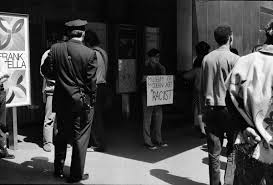
On November 28, 2011, Chris Mansour interviewed Julia Bryan-Wilson, Associate Professor of Modern and Contemporary Art at the University of California, Berkeley and the author of Art Workers: Radical Practice in the Vietnam War Era (2009). Mansour and Bryan-Wilson talked about the history of the Art Workers’ Coalition and its political relevance today, in light of the increasing involvement of artists and artistic strategies in the Occupy movement. What follows is an edited transcript. Art Workers’ Coalition (AWC) with the Art Action Group (GAAG), and the Black & Puerto Rican Emergency Cultural Coalition stiking outside the MoMA in 1970. —————————————————————————————- Chris Mansour: How did you come to study the artwork of what you call the “Vietnam War Era” and its relationship to the Art Workers’ Coalition (AWC)? Julia Bryan-Wilson: In the beginning—when I was still a young graduate student—I was drawn to a performance by the Guerrilla Art Action Group (GAAG) that occurred in the lobby of the Museum of Modern Art (MoMA) in 1969. It was a bloody, visceral action that called for the immediate resignation of all Rockefellers from MoMA’s Board of Trustees. At the time I was thinking about performance art as a form of protest, and how bodies in space—occupying space—meant to register certain activist concerns. Digging further into GAAG, I learned more about how they functioned as a direct action offshoot of the AWC. I wanted to do a project about the AWC, perhaps plumbing its history and laying out what really happened there, because there had at that point only been scattered accounts, and most of them were by people who were involved themselves, so there was not much critical distance. To me the AWC was a compelling, if short-lived, organization. I was also very intrigued by how many artists and well-known figures within the circle of contemporary art criticism participated in it. So it was not just people like Carl Andre and Dan Graham, but also critics such as Gregory Battcock, who was the editor of significant anthologies about “minimal art” and “idea art.” Some critics like Lucy Lippard and what were referred to as “low level curators” also saw themselves working within and amongst the AWC. But my focus shifted the further I delved into my research, and increasingly moved away from a strictly chronological account of the AWC towards larger questions of the politics of artistic labor in this moment, a moment when labor itself was radically transforming because of a shift to a postindustrial age. To me the intriguing question became not, “What happened to the AWC?” but rather, “How did understandings of artistic labor change in the wake of the formation of the AWC?” Also, how was artistic labor and broader political activism in mutual dialogue for a few key figures, such as Lippard or Hans Haacke? With my book, Art Workers, I never set out to write the comprehensive history of the AWC, but instead to think about the redefinition of artistic labor through figures that are very influential in contemporary art history, whose work has never been substantially talked about in relationship to this activism. CM: The main redefinition of artistic labor, as you elucidate in your book, starts with the distinct division between art and craft during the Renaissance era, as articulated by the art historian Michael Baxandall. But art as a form of labor really takes sway with the development of capitalism as a social structure. You reference a lot of Marx’s writings on art as labor in your book to make this case. You also mention the Artist Guild in England in the 1800s, the Artists Union in the 1930s, and so on. How did these diverse conceptualizations of art as a form of labor influence the AWC, and how do you see the AWC’s understanding of art as a form of labor as differing from older aesthetic concepts? JB-W: Those involved in the AWC had many different, and quite uneven, levels of sophistication regarding Marxist theory. Some of them knew nothing about Marxism, and were kind of going along with the flow or absorbing things that were ever-present in the atmosphere of the times. Others, like Carl Andre, were rather more serious students of Marxist theory. Of course, Marxist theories are also contentious and contradictory with regards to how art might or might not function as a kind of labor under capitalist forms of production. Even for Marx himself there is some friction regarding the role of patronage, creating a product for a potential market, and how making art might be understood as “free” or unalienated labor. So when artists turned to what was often half-understood Marxist theory in the late 1960s to call themselves workers, it proved to be fairly unstable ground. But the people in the AWC did have some historical precedents regarding the relationship of art and politics: They knew something about the Russian Constructivists, who called themselves “art workers.” They also knew a lot about the WPA moment and the Artists’ Union in New York, because some of those involved were still around. But the AWC was founded during a totally different cultural context than the Artists Union in the 1930s. The WPA employed artists under the rubric of a state sponsored program. Artists in the 1960s–70s were working with strongly anti-governmental precepts, and it was difficult to make the WPA type of artistic labor fit their vision, since that was, in their minds, akin to making Social Realist murals under the guidance of a corrupt state. Those in the AWC wanted to be free to make recalcitrant art like Minimalism and Conceptualism. But they still wanted their work to be considered a form of labor. CM: You also note that the members of the Artists’ Union—who were employed by the government—were substantially wage laborers, whereas a lot of the artists in the AWC and those affiliated with it supported freelance workers. So was it the case that the kind of political mobilization that the AWC had to seek out was qualitatively different
Letters To The Editor

Rabindra Kumar Dasgupta [Professor Rabindra Kumar Dasgupta enjoyed an illustrious academic career, holding numerous academic and administrative positions, including the Tagore Professorship in the Department of Modern Indian Languages in Delhi University. He had a DPhil on a work that closely studied the writings of John Milton and another PhD delving deep into the works of Michael Madhusudan Dutt. 2014 is his birth centenary year. Among other things, he wrote a great number of letters to the editor—in The Statesman and in The Assam Tribune. Those letters have now been collected in a book titled Letters to the Editor (Gangchil). It is one way, as Professor Sourin Bhattacharya, in his opening remarks to the book says, to get round the element of ephemerality. I still recall the frail and benign figure of Professor Dasgupta climbing up the stairs of Jadavpur University in the mid-1990s and in a remarkably lucid fashion, explain to us Plato’s Ion. He would transport us to a different world, week after week. Here are three of his letters. Prasanta Chakravarty (for HUG)] ——————————————————– Dead Weight of Printed Knowledge Sir , –The grand Boi Mela (Book Fair) which gives a new life to our city every year prompts me, a man of 88 years and seven months, stricken with a pernicious bronchial asthma, to speak of Mela Boi (too many books). My grandmother had only three books Krittibasi Ramayana, Kashidasi Mahabharat and Vijay Gupta’s Manasamangal. I remember she had a preference for the Ramayana which she read for an hour before her sleep at noon. I envy my grandmother for her economy of books and in my good days read for many more hours. But what have I gained for possessing so many books and giving so much time to them? Nothing except some academic trappings which I now think are but tinsels and some academic positions to which I have failed to do justice. Perhaps I fancied books just as some women fancy jewellery. I remember K. C. Mukherjee, who taught us Aristotle’s Poetics at Calcutta University, once quoted some two pages from Homer’s Greek and when I asked him how could he remember so much he said—“Young man you read all kinds of rubbish, I read only Homer.” I think the world is now sinking under the dead weight of its printed knowledge. Virgil knew more than Homer, but Homer is the greater poet. Milton knew more than Virgil, but Virgil is the greater poet. There may be some truth in Macaulay’s saying that as civilization advances poetry almost necessarily declines. Ramendrasundar Trivedi almost the same thing in his essay ‘Mahakavyer Lakhshan.’ And towards the end of the first world was Oswald Spengler wrote his The Decline of the West asking us not to write poetry but to produce machines. The world has not stopped writing poetry, but has produced so many machines that the Pentagon has now enough nuclear heads to destroy the world in several hours. It is this which has made the United States a menace to human civilization. Let us begin to realize the symbolism of Aeschylus’s play in which Zeus punishes Prometheus for bringing fire from heaven and giving it to men. Our Faustian lust for knowledge will ultimately reduce the world to ashes. I am now too frail to hold a book for reading and what is worse I begin to doze within five minutes of my taking a book in hand. So lying in bed which is my usual position. I silently recite to myself what odd bits I read in the past. The line which comes to my mind at this time of my life when I have lost so many of my near and dear ones is Goethe’s “ You must do without, you must do without.” I do not love to turn to Shakespeare’s soliloquies although I remember many of them. For me the most stirring words in Shakespeare are Cleopatra’s “ Give me my robe. Put on my crown. I have/Immortal longing in me…? Methinks I hear/Antony call…/Husband I come.” My old eyes are wet with tears when I remember these words. The wily woman became a goddess while leaving the world. The line of Rabindranath which stirs me most is “Thou has made me endless.” But I was never a good teacher. What then makes one a good teacher. It is a sensitive and creative response to the text in hand. A good lecture is an expression of this response. I found it in my teacher of Shakespeare, P.C. Ghosh and two of my colleagues Tarak Nath Sen and Sisir Kumar Das.—Yours, etc., R. K. Dasgupta 17 February 2004. —————————- 150th Year of the Manifesto Sir,–I thought that the Marxist government of West Bengal would mount an exhibition of the various editions of the Communist Manifesto on the occasion of the 150th year of its publication towards the end of February 1848. It is strange that there has not been any function in this city in the more than three months and a half since that memorable date. Our state government has a department of Information and Culture and our Bangla Academy is a wing of that department. It should have been possible to hold such an exhibition and a series of lectures on this classic which is now a great human document. Its value is not in the least diminished by the collapse of the Soviet Union, the fall of the Berlin Wall and the disappearance of Communism from Eastern Europe. As a historic document of human progress it survives these historical events. Let us remember the memorable words of Engels on the Manifesto in his preface to its 1890 German edition: “the history of the Manifesto reflects the history of the modern working-class movement. At present it is doubtless the most widely circulated, the most international product of all Socialist literature, the common programme of many millions of workers of all countries from Siberia to California.” If at all an exhibition
“Why are you laughing?” : George Seferis In Conversation With Edmund Keeley

George Seferis, in conversation with Edmund Keeley Seferis was nearing the end of his longest visit to the United States at the time of this interview, which took place in late December of 1968. He had just completed a three-month term as fellow of the Institute for Advanced Study in Princeton, and he was in particularly good spirits because he felt that his visit had served for a kind of rejuvenation: an interlude free from the political tensions that had been building up for some months in Athens and the occasion for both reflection and performance. The latter included a series of readings—at Harvard, Princeton, Rutgers, Pittsburgh, Washington, D.C., and the YMHA Poetry Center in New York—Seferis reading in Greek and the interviewer in English, each appearance with its distinct qualities of excitement and response. In Pittsburgh, for example, the audience (composed mostly of local Greek-Americans) seemed bewildered by the poetry during the reading but responded to the poet during the reception afterward as they might to Greece’s exiled king. The New York reading began with an introduction by Senator Eugene McCarthy. During the discussion period several questions from the audience had to do specifically with the political situation in Greece. Seferis refused to answer them. He was thought to be evasive by some in the audience, but he held his ground, and during the dinner following the reading he gave his reasons in private: He didn’t consider it proper to criticize his government while a guest on foreign soil, safely outside the boundaries of the government’s displeasure. He saved his answers for his return to Greece: an uncompromising statement against the dictatorship presented to local and foreign correspondents in defiance of martial law and at obvious personal risk (The New York Times, March 29, 1969). The combination of diplomatic tact and high conscience that defines the political character of Seferis also colors his presence and personal style. He is a heavy man, his voice gentle when disengaged, his movements slow, almost lethargic at times; yet he has a habit of gripping your arm as he moves, and the grip, though amiable in the old-fashioned European manner, remains young and firm enough to give you word of the strength still in him. And the voice has a second edge that cuts sharply when he senses something dubious or facile challenging it. Then, on the diplomatic side again, comes a sense of humor: a love of nonsense, of the risqué joke, of kidding himself and others with a wry little moon of a smile that appears unexpectedly in his oval face—especially after he’s trapped his listener with the question: “Why are you laughing?” An American poet once referred to him as a “Middle-Eastern troglodyte” in a poem about his first reading in New York some years ago. When the interviewer finally got up the courage to show him the poem, Seferis fixed him with a sharp, uncompromising look. “Middle-Eastern troglodyte. Ridiculous and inaccurate. I once called myself a Cappadocian troglodyte, and that is what I plan to remain. Why are you laughing?” Then the smile. The interview took place in the Seferis temporary home at the Institute for Advanced Study, an unpretentious second-floor apartment with three rooms, with a large window overlooking the grounds, the bookcase almost empty, none of the modern Greek paintings and classical treasures that set the style of the Seferis home in Athens. Yet the poet was delighted with the place because it gave him access to a number of exotic things: changing trees, and squirrels, and children crossing the lawn from school. His wife Maro—hair still gold and braided like a girl’s—was present throughout the interview, sometimes listening with apparent amusement, sometimes preparing food or drinks in the background. There were three recording sessions. Seferis would take a while to warm up with the microphone watching him from the coffee table, but whenever he began to reminisce about friends from the war years and before—Henry Miller, Durrell, Katsimbalis—or the years of his childhood, he would relax into his natural style and talk easily until the tape died out on him. ———————————————————– INTERVIEWER Let me start by asking you about the Institute for Advanced Study and how you feel, only recently retired from the diplomatic service, about beginning a new career as a student. GEORGE SEFERIS My dear, the problem which puzzles me is: What is advanced study? Should one try to forget, or to learn more, when one is at my stage of advanced study? Now I must say, on a more prosaic level, that I enjoy very much the whole situation here because there are very nice people, very good friends, and I enjoy—how shall I put it?—their horizons. There are many horizons around me: science, history, archaeology, theology, philosophy . . . INTERVIEWER But don’t you feel out of place among so many scientists? So many historians? SEFERIS No, because I am attracted by people whose interests are not in my own area. INTERVIEWER Do you think there’s an advantage—as I think Cavafy would probably have thought—to being in dialogue with historians? In other words, do you feel that history has something particular to say to the poet? SEFERIS If you remember, Cavafy was proud of having a sense of history. He used to say: “I am a man of history”—something like that, I don’t remember the exact quotation. I am not that way; but still, I feel the pressure of history. In another way, perhaps: more mythological, more abstract, or more concrete . . . I don’t know. INTERVIEWER How about the relation of the Greek poet to his particular historical tradition? You once said that there is no ancient Greece in Greece. What did you mean by that exactly? SEFERIS I meant Greece is a continuous process. In English the expression “ancient Greece” includes the meaning of “finished,” whereas for us Greece goes on living, for better or for worse; it is in life, has not expired yet. That is a fact. One can