
Bhaskar Chakrabarty’s Diary—1982: A Selection

1/1 Gist. A political journalist is more than a prostitute. 1/1 a poem is a deer with a dream in it. 1/1 Defeat becomes us. 14/1 Piku-Sadgati— incomparable, incomparable 29/1 If you want to catch a thief, kick the police. 30/1 Kamalda’s painting exhibition—academy of fine arts. 3/2 Orphee. This Cocteau film I had probably seen ten years ago. Watched it again today. Timeless classic. Kamalda’s painting exhibition. 5/2 Jule et Jim. Incomparable. Kamalda’s exhibition over. 10/2 Have to bring such a kind of laughter into grasp that nothing will ever make it fade. 10/2 A man’s body lying in this room, burnt to death. 19/2 Akaler Shondhane. How a good film can be ruined, Mrinalbabu shows at the end. Weight – 70 kg 5/3 Is it because I have been able to love that I am suffering so every day? 17/3 They read quickly, badly, and pass judgement before they have understood.—J.P.S. If the poet relates, explains , or teaches, the poetry becomes prosaic; he has lost the game.—J.P.S. 19/3 I must admit that I have never written any political poetry. But still, if someone calls any poem political, I will not be surprised. 22/3 Lochandas Karigaar is a memorable experience. 7/4 Bought a book for Rs. 50. Sinned. 8/4 You can’t be misguided. 12/4 Sinned again. Book. Rs. 21.40. Adalat o Ekti Meye. 22/5 A procession of abortive poems. 1/6 Life is good. Very good. Death, not so much. 6/6 When everyone is running after money, I am writing poetry. No money if I fall ill again. How long shall Sejdi manage. 9/6 I will awake from within one day. Illumined, incandescent. Feels as if I am walking around in unknown, uncharted country. Relationships are getting denser—hesitantly. By no means am I lonely. 14/6 Huge trouble. Too many letters to write. Must list name and date from now on. We don’t have any secretary. 21/6 Learning to use words slowly, with time. Terrible poverty. 26/6 Truly, my deepest secret poems are like the light of imagination, running in a moment from hither to thither. As if I have really been blessed with a gift of two wings. How grateful am I to life. 30/6 After every single poem, one has to stir in suspicion and examine it closely—whether it is a poem indeed. 2/7 55 poems in 6 months! Never in my life. 4/7 Perhaps my shorter poems are buried under my prose-poems. Wrong thinking. Disrespectful. 6/7 Modern Times. Classical touch of a genius. 24/7 No letter even today! Everyone’s busy? 27/7 Reality, simplicity and humanity with superb imagination. B. C. 28/7 Have coughed the whole night. Who can survive so many cigarettes? 29/7 We never came to thoughts. They came to us. H. Not liking coffee house. We are too late for the God and too early for the Being. H. 2/8 One has to love even being swindled in life. 3/8 Alone at coffee house. Extra tension. I should live with children. Have not graded any examination script the whole day. Don’t know why, but I have never worked towards a lucrative job, marriage. Today, perhaps, I have inched pretty close to marriage. Discomfitting. 4/8 Hotel. Afternoon, 3.05. Daal-rice. Fried fish. 9/8 After a trillion years, this birth. She was my mother. He, my father. My young brother, sister, didi. A few friends. And then, just vanishing into the wide yonder. Again will not see them for many trillion years. This mystery beckons me today. 9/8 Exhausted. Need a break for a couple of days. Somewhere deserted—rest. Trysting with song—Santosh Sengupta, Dhiren Mitra and Ramkumar. 10/8 Common people’s words needs to be conveyed simply to the common people— Did the political parties ever realize this? Ever? 11/8 Let there be no vacuous optimism in my writing. 15/8 One more insignificant day. 18/ 8 If the front door is bolted, smash it to smithereens. Munna has fever. I feel it coming too. 24/8 Ceaselessly, to stand upon a rickety, tremulous life and write poetry. What excrutiating poverty. 25/8 So weak I have become. Continuously thinking of ma. 26/8 Be calm be calm just be calm. 27/8 This life I have wasted by writing. Had I not written, this life I would have wasted more. Terrible poverty. Losing joy in life again. Any which way, must rummage among the daily nuts and bolts of life for happiness. Must. 29/8 Spending since morning. 30/8 Weight—68 kg 2/9 Idiot! Learn how to lie. You will be happy. Have I to lie in order to be happy? 4/9 Why don’t those who want new kinds of writing from me go to the stationary shop? Coffee House. 7/9. Theory of rebirth. A consolation to earth-loving humans. These days the young ones engage in opinion-mongering. For me Bibhutibhushan’s Ichhamati is no less than And Quiet Flows the Don. 9/9 I painfully realize today that there is nothing I can do other than writing poetry. 15/9 Can we not ever get the vast star studded night into language, into poetry? Being my own friend and my own enemy I have done, continually, so many plain chores, wishing to die silently. 16/9 In every moment of life, rejection entangles us. One has to accept it. One has to love more. Anger, excitement– I must eliminate from life. I have forgotten the habit of walking on roads. Have to start afresh in a quiet way. 17/9 I have always played with danger since childhood. Paying the penalty for that today. When Sejdi, too, tells me to write prose, I feel really anguished. 20/9 Greed, I must win over. Restraint, a valuable gift. Impassivity, stay with me. Beware. Disquiet ahead. 22/9 Someone who slipslides away from another
Shrapnel Minima: The Acknowledgment Page
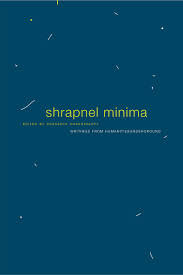
[ The humanitiesunderground book is about to appear soon. Within a month’s time perhaps. We thank every single well wisher and reader. Below, a reproduction of the acknowledgment page.] tutulova & all my students— past, present and future Aknowledgement Gone are the days of deft touch. And hauteur. People are jogging playing eating dancing writing making friends in order to win. But humanities is not about winning. It is a different trip. Only those who have experienced loss and defeat again and again in life have the right to read poetry or epic. One has to earn this right. But we are rejecting this suicidal, cosmic urge. We are separating literature from life or considering art as a pleasing form of exercise leading to inspired creativity. Our best minds are keeping the forgotten and the defeated out of their circles. Something singular is happening around us in India. May be around the world. Our natural inclination for the angular and the passionate, the irreverent and the metaphorical, the despairing and the restless is brimming but we hardly see these moods expressed—in print or on the internet, as graffiti or in popular iconography! We have made sure our humanities departments remain professional coops, at best procedural debating societies. Quite naturally, our sense of the pointedly political, our sensuous immersion in beings and bodies around us and our rasa-bodha–aesthetic sensibility—are unable to cohere and conjoin. Or so it seems. For, in Haldwani, Uttarakhand, Ashok Pande is silently laying out and scattering the spirit of humanities through his blog Kabaadkhaana. He has scant interest in being topical. His world is quaint and quirky and through an expansive vision he is richly measuring our time. In Darjeeling, West Bengal Sumanta Mukhopadhyay conceives our terrifying and confident new India as a myth, endlessly repeated as history. But innovate he must, instead of looking inward. Thus begins his cycle of poems. At Jabalpur, Madhya Pradesh, coffee houses are abuzz and still frequented by the editor and writer Gyanranjan and his committed band every single day so that they can chalk and plan life and literature; this, a few hours away from Bhopal where the aesthetic war has long been raging with the power brokers of Bharat Bhavan. The battle lines will be far tougher in the days to come. In Patna, Bihar, Krishna Kalpit is aphoristically and cosmologically capturing our times along with two of his intimate friends—Parth and Sartre! At Dungarpur, Rajasthan, Himanshu Pandya is teaching, writing, organizing and directing us towards the sharpest of writings coming out of the smallest of places from the whole of North India. Come every Sunday, Upal Deb, from Guwahati, Assam is expanding our lust for life by gifting us a new set of poems on the internet, chosen meticulously from a dazzling spectrum of poets from all around the world. He is grounded and astutely political. Friends are reading humanitiesunderground. Friends are contributing. New friends are joining in. Salaam to Manash Bhattacharjee, Trina Nileena Banerjee and Richa Burman for fostering a sense of demanding ease and occasional splashes of laidback drizzle in this parched world of insecurity and one-upmanship. Moinak Biswas reserves and retains faith in our collective ‘party office’ and Soumyabrata Choudhury continues to push the boundaries of intellect and performance. In unknown, inexplicable ways, both of them, their ways of looking into art and politics and styling of the persona have shaped humanitiesunderground. Salut. Varuni Bhatia, Sharmadip Basu, Arundhati Ghosh, Srirupa Prasad, Niharika Banerjea, Bhaswati Ghosh, Aryak Guha, Mrinalini Chakravorty, Santanu Das, Subha Mukherjee, Joad Raymond, Geeta Patel, Anil Menon, Samantak Das, T.P. Sabitha, Saurabh Dube, Nauman Naqvi, Amitranjan Basu, Indranil Chakraborty, Shrimoy Roy Chowdhury, Prashant Keshavmurthy, Gautam Basu Thakur, Ravindran Sriramchandran, Oishik Sircar, Amrit Gangar, Parimal Bhattacharya, Amrita Dhar, Phalguni Ghosh, Sumana Roy, Ananya Mukherjee, Ananya Dutta Gupta, Rana Roychowdhury, Paulomi Chakraborty, Kamalika Mukherjee, Shubhasree Bhattacharya and Pavel Chakraborty—I thank all of you for supporting and espousing humanitiesunderground from afar. Amlan Dasgupta, Michael Levenson, Jairus Banaji, Rimli Bhattacharya, Ajay Skaria, Tista Bagchi, Sunalini Kumar, G. Arunima, Rahul Govind, Rina Ramdev, Akhil Katyal, Anchita Ghatak, Saroj Giri, Sanghamitra Misra, Franson Manjali, Puttezhath Sunil Menon, Moushumi Bhowmik, Aditya Nigam, Avik Bannerjee, Arundhati Chakrabarti, Maya Joshi and Sunit Singh for interventions, suggestions and encouragement at regular intervals. Piyali and Saurav Chakravarty your animated disposition in every activity drives me and you are present in every single atom of my life. I am forever grateful to Bhargavi & Srinjoy Mukherjee—for those fabulous weekends in Bangalore and endless sessions of adda that would take away the drudgery of closed, tedious academic routine. The wanderlust spirit of Tautik Das, Rohini Datta and Anirban Dutta amazes me to no end. They remain an absolute inspiration to any work that may foster questioning. Moutusi Maity and G.S. Chakravarty I cannot thank enough for their relentless argumentative spirit that daily makes me aware of other, significantly differing viewpoints and for entrusting faith in the underlying principles that shapes humanitiesunderground as an intellectual endeavor. And most of all: for putting up with my rant and habits, every single day. I am obliged to thank Ernesto Laclau and Jim Holstun—dazzling minds both. And whose divergent political ways and my proximity to both revealed to me how academia may not be an utterly self absorbed world. As the world turns decisively rightward, their viewpoints do not seem so contrastive. Nilanjan Guha—a more expansive and carefree spirit I am yet to see. Whenever doubts and vexations have bothered me, your ways and thoughts have acted as a tranquilizer. Pothik Ghosh—thank you for alerting me about some of Fredrick Jameson’s writings on modernism and for other ongoing debates. Your relentless correlating of the intellectual arsenal to everyday practices and resistance movements (or perhaps it is vice versa!) is a matter of inspiration. We strive for it and fall short. Rajarshi Dasgupta—may your ruthless intellectual pessimism clash ever more violently with your daily, passionate lust for languorous living. And Brinda Bose, may you continue to counter
Images of Listening: Word-Pictures from a Journey through Music

Moushumi Bhowmik and Sukanta Majumdar The pictures are spread before us like disjointed tiles—photographs from our long and entwined journey through music in Bengal. It’s two of us; one singer and writer, the other sound recordist and sound artist. We have been travelling together, sometimes also with friends, in this eastern part of the Indian subcontinent for almost a decade, recording music that comes out of people’s lives; in sound, image and text. On a cold and dry afternoon in January 2005, Golam Shah Fokir was playing music in his house in Shaspur village in Birbhum, West Bengal, India and we were recording him. ‘Take what you can,’ he said to the camera, ‘these might well be the last pictures.’ Also the last songs, as it turned out within a couple of months of our field trip. Golam Shah Fokir used to sing songs about the mysteries of the universe and the divine experience of love—they are called fokiri and murshidi gaan. For decades he had sung in shrines and festivals, gathering communities of listeners around him. The singer is also the teacher, imparting lessons to those who listen in faith, the insiders. Our presence was for a different purpose, hence our listening was also different; we knew Golam Shah would soon be gone and with him, a time in history. It is difficult to know how old he was then. Time can both weather, as well as make wiser. But he seemed to have a premonition of death and on this day he played it out almost with a sense of humour. Totally photogenic, he posed for the camera, singing, talking, instructing, smoking; conscious of all the attention he was drawing and the recording equipment that surrounded him in that passing moment. He knew the value of being recorded, he knew in his own way about the power of recordings to preserve time, for he kept instructing his sons Salam and Jamir to sing their best. We took pictures of him playing with his sons, alone with his old violin, with his wife, daughters, sons, their families, children, villagers, with his followers and friends and also with us. He had full sway over his domain that day, almost pushing his frail body, voice and breath beyond their limits. We captured his image as he listened to our recording of his songs; then returned the headphones satisfied, saying, ‘Khub high class!’ Uttar Shobharampur jari মাদুর harmonium Akbar HOSSAIN torch Jainuddin mini disc Faridpur Sylhet chandrabati ভায়োলিন কোম্পানি headphones maadur dhol লন্ঠন HEADPHONES Probhati sandals Jasimuddin Kumar nodi Ma Fatema TASCAM HD recorder তবলা utshaho Sushoma Ahmadpur রসের জাউ Asmani Namaaz tube-well HEADPHONES maadur Montu hurigaan Surma nodi Ibrahim Boyati শম্ভুনাথের চায়ের দোকান condenser mic cycle-rickshaw মাসিমা Hobu-Pagla headphones khol CHANDIDAS bichchhed First there is the performance, the moment of the making of the music, which is also the moment of recording, as well as the moment of experiencing the music live; then follows the ritual of listening to the recording. Sometimes we have conversation with the players, then we too—mostly Moushumi—become players. Sukanta silently records. He passes around the headphones after the recording is over, some listen, others look on. Later we look at photographs of singers and audiences caught in the act of listening. Words emanate from the images—words, the sound of the words, word-pictures, evoking memory and desire. There are different ways of listening and different expectations written on these varied faces. Chandrabati mashima, who was about 78 when we first recorded her in her home in Sylhet town in 2006, had appeared totally self-conscious from the beginning. She would stop us in the middle of the song if she felt she had made a mistake. Erase that bit, she said to Sukanta. Then when she listened to the recording, it seemed as if she was intently examining her reflection in the mirror. A smile of contentment lit up her face from time to time. At the other end of the spectrum, far from this personal response, would be an obscure village by the Surma river called Shadhusree, also in the Sylhet region, where both singer and audience had collectively made music all through a night in the Spring of 2008. Such is the nature of this music—it is ritualistic and communal. At the break of dawn they listened together to their songs. It is such an absorbing image! One listens, others look on in anticipation, trying to guess at the sound from the expression on the listener’s face, who is actually listening alone, through headphones. In our heads, their last song ushering in a new day, the probhati, keeps playing, long after it is over. Probhato samay kale, Shachiro angina majhe/Gourchand nachiya beray re. The mad poet sings and dances at dawn, touching his listeners with the spirit of love. We talk about ourselves. Sometimes I think I miss the touch of the skin of the sound. My listening is mediated by the machine, filtered through the microphone, recorder and headphones. I also miss seeing all the things going on around me. I feel inadequate in other ways. I am too focused on the immediate and obvious to hear anything else. Sometimes the visual distracts me. Often it is only in your recording that I hear the details. Think how Hajera Bibi of Faridpur was talking about another time in her life which was filled with people. She kept saying, my voice wasn’t like this, this is no song that I am singing, remember? Yes, the dog barked and there was the prayer call of nightfall in the distance. Isha’a. Someone was drawing water from the screeching hand pump in the courtyard. A child was crying, her grandniece’s I think. Hajera Bibi was trying to recall names and words of songs. I know. I’ve heard that fading light in your recording. —————————————————— Moushumi Bhowmik, singer and writer, and Sukanta
On ‘Mudradosh’: Jibanananda Das and the Paradox of Subjectivity

Nazmul Sultan [Nazmul Sultan is a PhD student in Political Theory at the University of Chicago. He is also one of the editors of Itihashjan, a journal of politics and philosophy in Bengali.] 1. Mudradosh[i] evades the order of thought. Stealthily escaping the world of conscious authority, it recurs again and again, restlessly and relentlessly. At the first blush, the prime constituent of mudradosh appears to be the act of self-circling repetition. Mudradosh is that over which the subject has no real authority, for it does not rely on the sovereign decision of the subject. It is indeed a habit—a habit of both thought and action. And yet we understand little by reducing mudradosh to the category of habit. In some sense, everything is a form of habit. The all too well-known Humean argument that knowledge itself is a product of the custom and habit that govern our thought and action does not help much in understanding the singularity of mudradosh. For Hume, the source of knowledge is not any transcendental foundation of reason, but rather the fundamentally habitual nature of human thought and action that generates epistemic beliefs. Although Hume recognizes the centrality of the self in conceiving passions and emotions, these sensibilities remained grounded in the impressions that result from encounter with external objects and events. The self, as it were, is the medium that arranges the impression-produced beliefs in certain orders. In contrast, mudradosh refers to the repetitive failure of the subject itself. Mudradosh is distinguished from the generality of habit by virtue of its peculiar constitution—the coming together of “mudra” and “dosh” (fault). It is not quite easy to define mudra, a highly polysemous word. In ancient Indian philosophy, mudra denoted the gesture which is both symbolic and ritualistic. It is a physical act above all, one that designates gestures of yoga, dance, and so on. Given the embodiment of an authorized symbol on its body, coin itself is called mudra in several Indian languages. When a particular mudra is not reproduced in the authentic form, the resultant imperfect action is categorized as mudradosh. For example, the constitutive limit of a dancer may lead her to perform a mudra that deviates from the standard norm. Mudradosh is thus different from mannerism in the sense that it is not simply a whimsical particularity of an action. It entails the failure to meet the requirements of a ritualized norm. Yet mudradosh is not a transgression per se—for the failure is involuntary and is often tolerated. In other words, mudradosh is neither fully accepted nor is it fully signified with the status of a taboo. Between permissibility and revocation, mudradosh exists as an ambivalent subjective failure which has no traceable cause. The execution of an action that fits with the norm does not solicit any special attention. In the case of transgressing the boundary and committing a taboo, the action is readily identified as illegitimate and accordingly penalized. The one who commits mudradosh stands in between these two extremities. Mudradosh does get identified as a deviation from the norm, but the level of transgression is not so extreme as to delegitimize the action or to banish the accused. In the jungle of norm and ritual-constituted habits, mudradosh hangs like an insignificant shrub. The one who breaks the taboo gets no time for redemption, mediation, and dwelling with her deed—there is no scope for transcending the taboo from within (it can only be done from the outside). The one who is accused of mudradosh is allowed to dwell with her failure. Her way is therefore laid with tensions and contradictions amid the lingering pressure of repetitive failure. Jibanananda Das—one of the most influential modern Bengali poets, one whose immense popularity unfortunately did not quite translate into an appreciation of his philosophical genius—problematized mudradosh in a way that knots it with the paradox of subjectivity. As long as the beings are one with the world, they are not yet subjects. And when they discern the non-identity and autonomy, they are not presented with the sovereign power over themselves, let alone over the world. The poem that catapulted Jibanananda onto the chaotic plane of modernist Bangla literature, Bodh (1929), is nothing less than an exploration of this paradox of subjectivity. Mudradosh is one of the central problems of Bodh, even as this word is used only once in the course of the poem. The poem begins with the torment of the self that has been split into two parts. The split-part that narrates the poem wants to recuperate the state of oneness with the world. Jibanananda calls the “subject” who wants to identify with the world as sahaj lok (unified and spontaneous folks). The concept of sahaja—a basic tenet of the Vaishnava tradition—describes the realization of the self in the truth of unity. This is a state where the lover and the loved—i.e., the subject and the object—dissolves into the truth of oneness. As Ananda Coomaraswamy observed,“It [sahaja] is a release from the ego and from becoming: it is the realisation of self and of entity—when ‘nothing of ourself is left in us.’”[ii] Jibanananda deconstructs this idea of the sahaja, artfully collapsing the philosophical and the sociological by way of drawing a passage between sahaj lok (spontaneous and unified folks) and sakal lok (everyman). Neutralizing the drive of becoming, the sahaj lok spontaneously identifies itself with the nature. The narrator of the poem is disturbed, intrigued, and alarmed by the emergence of a cognizance that is forcing the self to become separated from itself and from the naturalized world. The observer I—the self that seeks to align with the sahaja—narrates its futile struggle to return to the world of oneness. Recounting that it too has performed everything that spontaneously unified folks do, it wonders why it is still not able to ward off the alienating cognizance. Introducing non-identity in the self, the very notion of “cognizance” forces the subject to move toward the negative and the incomplete. The narrator