
Shrapnel Minima: The Acknowledgment Page
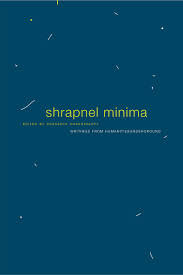
[ The humanitiesunderground book is about to appear soon. Within a month’s time perhaps. We thank every single well wisher and reader. Below, a reproduction of the acknowledgment page.] tutulova & all my students— past, present and future Aknowledgement Gone are the days of deft touch. And hauteur. People are jogging playing eating dancing writing making friends in order to win. But humanities is not about winning. It is a different trip. Only those who have experienced loss and defeat again and again in life have the right to read poetry or epic. One has to earn this right. But we are rejecting this suicidal, cosmic urge. We are separating literature from life or considering art as a pleasing form of exercise leading to inspired creativity. Our best minds are keeping the forgotten and the defeated out of their circles. Something singular is happening around us in India. May be around the world. Our natural inclination for the angular and the passionate, the irreverent and the metaphorical, the despairing and the restless is brimming but we hardly see these moods expressed—in print or on the internet, as graffiti or in popular iconography! We have made sure our humanities departments remain professional coops, at best procedural debating societies. Quite naturally, our sense of the pointedly political, our sensuous immersion in beings and bodies around us and our rasa-bodha–aesthetic sensibility—are unable to cohere and conjoin. Or so it seems. For, in Haldwani, Uttarakhand, Ashok Pande is silently laying out and scattering the spirit of humanities through his blog Kabaadkhaana. He has scant interest in being topical. His world is quaint and quirky and through an expansive vision he is richly measuring our time. In Darjeeling, West Bengal Sumanta Mukhopadhyay conceives our terrifying and confident new India as a myth, endlessly repeated as history. But innovate he must, instead of looking inward. Thus begins his cycle of poems. At Jabalpur, Madhya Pradesh, coffee houses are abuzz and still frequented by the editor and writer Gyanranjan and his committed band every single day so that they can chalk and plan life and literature; this, a few hours away from Bhopal where the aesthetic war has long been raging with the power brokers of Bharat Bhavan. The battle lines will be far tougher in the days to come. In Patna, Bihar, Krishna Kalpit is aphoristically and cosmologically capturing our times along with two of his intimate friends—Parth and Sartre! At Dungarpur, Rajasthan, Himanshu Pandya is teaching, writing, organizing and directing us towards the sharpest of writings coming out of the smallest of places from the whole of North India. Come every Sunday, Upal Deb, from Guwahati, Assam is expanding our lust for life by gifting us a new set of poems on the internet, chosen meticulously from a dazzling spectrum of poets from all around the world. He is grounded and astutely political. Friends are reading humanitiesunderground. Friends are contributing. New friends are joining in. Salaam to Manash Bhattacharjee, Trina Nileena Banerjee and Richa Burman for fostering a sense of demanding ease and occasional splashes of laidback drizzle in this parched world of insecurity and one-upmanship. Moinak Biswas reserves and retains faith in our collective ‘party office’ and Soumyabrata Choudhury continues to push the boundaries of intellect and performance. In unknown, inexplicable ways, both of them, their ways of looking into art and politics and styling of the persona have shaped humanitiesunderground. Salut. Varuni Bhatia, Sharmadip Basu, Arundhati Ghosh, Srirupa Prasad, Niharika Banerjea, Bhaswati Ghosh, Aryak Guha, Mrinalini Chakravorty, Santanu Das, Subha Mukherjee, Joad Raymond, Geeta Patel, Anil Menon, Samantak Das, T.P. Sabitha, Saurabh Dube, Nauman Naqvi, Amitranjan Basu, Indranil Chakraborty, Shrimoy Roy Chowdhury, Prashant Keshavmurthy, Gautam Basu Thakur, Ravindran Sriramchandran, Oishik Sircar, Amrit Gangar, Parimal Bhattacharya, Amrita Dhar, Phalguni Ghosh, Sumana Roy, Ananya Mukherjee, Ananya Dutta Gupta, Rana Roychowdhury, Paulomi Chakraborty, Kamalika Mukherjee, Shubhasree Bhattacharya and Pavel Chakraborty—I thank all of you for supporting and espousing humanitiesunderground from afar. Amlan Dasgupta, Michael Levenson, Jairus Banaji, Rimli Bhattacharya, Ajay Skaria, Tista Bagchi, Sunalini Kumar, G. Arunima, Rahul Govind, Rina Ramdev, Akhil Katyal, Anchita Ghatak, Saroj Giri, Sanghamitra Misra, Franson Manjali, Puttezhath Sunil Menon, Moushumi Bhowmik, Aditya Nigam, Avik Bannerjee, Arundhati Chakrabarti, Maya Joshi and Sunit Singh for interventions, suggestions and encouragement at regular intervals. Piyali and Saurav Chakravarty your animated disposition in every activity drives me and you are present in every single atom of my life. I am forever grateful to Bhargavi & Srinjoy Mukherjee—for those fabulous weekends in Bangalore and endless sessions of adda that would take away the drudgery of closed, tedious academic routine. The wanderlust spirit of Tautik Das, Rohini Datta and Anirban Dutta amazes me to no end. They remain an absolute inspiration to any work that may foster questioning. Moutusi Maity and G.S. Chakravarty I cannot thank enough for their relentless argumentative spirit that daily makes me aware of other, significantly differing viewpoints and for entrusting faith in the underlying principles that shapes humanitiesunderground as an intellectual endeavor. And most of all: for putting up with my rant and habits, every single day. I am obliged to thank Ernesto Laclau and Jim Holstun—dazzling minds both. And whose divergent political ways and my proximity to both revealed to me how academia may not be an utterly self absorbed world. As the world turns decisively rightward, their viewpoints do not seem so contrastive. Nilanjan Guha—a more expansive and carefree spirit I am yet to see. Whenever doubts and vexations have bothered me, your ways and thoughts have acted as a tranquilizer. Pothik Ghosh—thank you for alerting me about some of Fredrick Jameson’s writings on modernism and for other ongoing debates. Your relentless correlating of the intellectual arsenal to everyday practices and resistance movements (or perhaps it is vice versa!) is a matter of inspiration. We strive for it and fall short. Rajarshi Dasgupta—may your ruthless intellectual pessimism clash ever more violently with your daily, passionate lust for languorous living. And Brinda Bose, may you continue to counter
‘Irreparable Loss Should Be Forgotten As Soon As Possible’

In a conversation with Anil Sinha, Vamik Jaunpuri also says, ‘Poems should not be slogans but they must be loud enough.’ The interview appeared in a Commemorative volume for Anil Sinha, published by the Anil Sinha Memorial Foundation in 2014. Translation: HUG. Introduction: Anil Sinha The 85 year old Urdu poet (born: February 23, 1910) has seen many ups and downs in life, poetry and in organizational politics. He has an in-depth understanding of the role of the poet, the poet’s craft and his relationship to society. To have an audience with him is like traversing through a few eras all at once. He has published five books so far, four among those are books of poetry—Cheekh( 1948), Jaras (1950), Shab Charag (1978) and Safre Na Tamam. His autobiography is titled—Guftani Ka Guftani, which I had read in Patna’s Khuda Baksh Khan Library. He believes that a poet’s journey is never-ending, since humanity and society never come to an end. He joined the Progressive Writer’s Association in 1972. His poem ‘Bhukha Hai Bangal’ became a great hit. It had instantly spread byword-of-mouth and was on everyone’s lips at that time. He was formally associated with the collective till 1950 until his straight talk, and obligation towards poetry and society,led to his marginalization. To date, his position in the organization is not very sound and yet all his love and lore has always centred on the P.W.A. The ideal, that he ought not to abandon an organization with which he has been associated right from inception, never left him. Most of his poems are the finest of treasures and a bequest of the home grown Indian thought process. He was quite unknown to the Hindi world. Usually Vamik Sa’ab was a man of few words, but whenever he did decide to speak—he would go all the way. Ajay Kumar of Jaunpur has helped me in appreciating and making sense of the Urdu lafz that he has often used in the course of our discussion. This conversation dwells on poetry and politics, and their relationship. We also discuss poets and litterateurs and their intellectual role in matters social. As we enter through the enormous gate of the almost 200 year old Lal Kothi I remember a snippet of Ghalib’s famous sher –उग रहा है दरो-दीवार पर सबजा ग़ालिब“…germinating vegetables on the walls and portals Ghalib.” But these walls and entrances were not marked with decay and loss; they opened us up to a throbbing, transformative, great and living poet, forever eager and restless to dream and instantiate a happier, freer and egalitarian life for his fellow beings. Vamik Jaunpuri, at 85—seeking and searching Urdu’s real spread and enlargement, is very much the same creative persona that we have known for so many decades. Vamik Sa’ab, who has forever tried to take poetry to an elevated height, thinks that to be a poet is to be a paigambar—a prophet. If a prophet means someone who, for the betterment of the world, for the sake of a peaceful future, works toward bringing forth an equitable world into existence, so does the poet. By presenting before us testimonies of daily struggles, the poet stirs us with energy and furore so that one may imagine a more equitable and just society. This idea of the poet as a prophet is much of Vamik Sa’ab’s belief and it means that in his own way he is aware of his responsibility to contribute to nation building. So, he would often draw portraits of those higher prophets with china ink—the likes of Tagore or Ghalib, for instance. We reach a veranda in Lal Kothi. The rain soaked sun shines lightly and the spotless sky is reflected in the green grass and brambles on the walls. On the other side of the veranda a greying poet with his paan-dabba sits on his easy chair. The dabba is placed over an old, dilapidated chowki. The poet’s eyes burn. I am with Ajay Kumar, I say, and the poet greets him—“Come Ajay, if Begum was alive, she would have offered you paan right now.” In his thoughts I could see his begum—his homemaker, sakhi, secretary too perhaps. And as he stands up and makes us comfortable—he says; “Irreparable loss should be forgotten as soon as possible.” One can see why Vamik Sa’ab, in spite of relentless pressure from his sons and friends, is beholden to his soil, his world. “ए मेरे प्यारी ज़मी / नौर सो नाज़ आफ़रीं/तेरे चमनजन पर/हुस्न की सरशारियां /फ़िक्र की महमेज़ पर /फन से तो जन्नत निशाँ /गगन ज़लज़लों के क़र्ज़ में, जन तुझे ठंडक मिली /आदमी की भी बनी/आशिके मज़दूर तू …” This zamin begins in Lal Kothi but spreads all over India. He says, thinking deeply, dreamily —that a new mutiny is needed now. Fresh and fecund.The ones who are dividing the nation and are hell bent on keeping the poor in their rightful place—it’s they whoshould be worried instead, not the poor. Their dreams must never be fulfilled. One should think of a fresh blueprint. Ever optimistic, he believes that such a future is not very far, that such sentiments might again stir our nation, especially in the rural sector. Mutiny itself is a sentiment and a powerful, hidden one too. One who understands this sentiment might work towards shahadat(martyrdom). This sentiment was very much present in Ashfaqulla Khan and Bhagat Singh, he ponders. In my ancestry too, there has been a tradition of such sentiments. One can use the very idea of being a shahid (martyr) in making a surat (representation/face)—that is, for composing art and literature. This very idea of inquilabi poetry should be the basis of our writing, he feels. Now, more than ever. Otherwise we are destined to fall into a bottomless pit. ********************************* Anil Sinha: Can you please tell us a bit more about these powers that are trying to get the country into a morass? Vamik Jaunpuri: Do I need to explain it after all that has happened? You too have been
An Animal, A Night, A Scream

Constant Nieuwenhuys [Constant Nieuwenhuys (1920-2005), the Dutch painter, sculptor, graphic artist, author, musician and architect, along with Asger Jorn, initiated the avant-garde art movement CoBrA (1948-51). In July 1948 Constant founded Reflex, Experimentele Groep in Holland with Karl Appel, Corneille and his brother Jan Nieuwenhuys. For Constant, art had to be experimental. He had deducted this from the French word ‘expérience’ and believe that art springs from experience of the artist and is continuously changing. The first edition of the magazine Reflex was published with a manifesto written by Constant (Reflex # 1-September/October, 1948).This manifesto would become one of the most important texts on art in the Netherlands after WWII. In this manifesto he states that firstly the process of creation is more important to the experimental artist than the work itself. HUG reproduces the Manifesto in anticipation of the impending publication of Henre Lefevbre’s hitherto unpublished work in any language: Toward An Architecture of Enjoyment (trans. Robert Bonnono, University of Minnesota Press, forthcoming June, 2014). Lefevbre was closely connected to Constant and Asger Jorn, and like them, made asceticism his prime target of critique, which they all detected in bourgeois morality, capitalist accumulation, modernist aesthetics, structuralist epistemology, bureaucratic governance, and the political imaginary of the communist Left. All plates by Constant Nieuwenhuys] ————————— Translated by Leonard Bright The dissolution of Western Classical culture is a phenomenon that can be understood only against the background of a social evolution which can end in the total collapse of a principle of society thousands of years old and its replacement by a system whose laws are based on the immediate demands of human vitality. The influence the ruling classes have wielded over the creative consciousness in history has reduced art to an increasingly dependent position, until finally the real psychic function of that art was attainable only for a few spirits of genius who in their frustration and after a long struggle were able to break out of the conventions of form and rediscover the basic principles of all creative activity. Together with the class society from which it emerged, this culture of the individual is faced by destruction too, as the former’s institutions, kept alive artificially, offer no further opportunities for the creative imagination and only impede the free expression of human vitality. All the isms so typical of the last fifty years of art history represent so many attempts to bring new life to this culture and to adapt its aesthetic to the barren ground of its social environment. Modern art, suffering from a permanent tendency to the constructive, an obsession with objectivity (brought on by the disease that has destroyed our speculative-idealizing culture), stands isolated and powerless in a society which seems bent on its own destruction. As the extension of a style created for the social elite, with the disappearance of that elite modern art has lost its social justification and is confronted only by the criticism formulated by a clique of connoisseurs and amateurs. Western art, once the celebrator of emperors and popes, turned to serve the newly powerful bourgeoisie, becoming an instrument of the glorification of bourgeois ideals. Now that these ideals have become a fiction with the disappearance of their economic base, a new era is upon us, in which the matrix of cultural conventions loses its significance and a new freedom can be won from the most primary source of life. But, just as with a social revolution, this spiritual revolution cannot be enticed without conflict. Stubbornly the bourgeois mind clutches on its aesthetic ideal and in a last, desperate effort employs all its wiles to convert the indifferent masses to the same belief. Taking advantage of the general lack of interest, suggestions are made of a special social needs for what is referred to as ‘an ideal of beauty,’ all designed to prevent the flowering of a new, conflicting sense of beauty which emerges from the vital emotions. As early as the end of World War I the Dada movement tried by violent means to break away from the old ideal of beauty. Although the movement concentrated increasingly on the political arena, as the artists involved perceived that their struggle for freedom brought them into conflict with the laws that formed the very foundations of society, the vital power released by this confrontation also stimulated the birth of a new artistic vision. In 1924 the Surrealist Manifesto appeared, revealing a hitherto hidden creative impulse – it seemed that a new source of inspiration had been discovered. But Breton’s movement suffocated in its own intellectualism, without ever converting its basic principle into a tangible value. For Surrealism was an art of ideas and as such also infected by the disease of past class culture, while the movement failed to destroy the values this culture proclaimed in its own justification. It is precisely this act of destruction that forms the key to the liberation of the human spirit from passivity. It is the basic precondition for the flowering of a people’s art that encompasses everyone. The general social impotence, the passivity of the masses, are an indication of the brakes that cultural norms apply to the natural expression of the forces of life. For the satisfaction of this primitive need for vital expression is the driving force of life, the cure for every form of vital weakness. It transforms art into a power for spiritual health. As such it is the property of all and for this reason every limitation that reduces art to the reserve of a small group of specialists, connoisseurs, and virtuosi must be removed. But this people’s art is not an art that necessarily conforms to the norms set by the people, for they expect what they were brought up they with, unless they have had the opportunity to experience something different. In other words, unless the people themselves are actively involved in the making of art. A people art is a form of expression nourished only by a natural and therefore general urge to expression. Instead
The Final Womb: A Script

Falguni Roy [Falguni Roy, poet and visionary— one of the rarest of rare voices from the subcontinent, died at the unripe age of 33 in May, 1981. HUG thanks Abhisek Chakraborty for collecting his work along with allied and contemporary writings in the same tradition—in the February 2014 volume of the magazine Eksho Ashi Degree. Here is a sample. Translation: HUG. A short film about Roy, Ebang Falguni (The Lost Lines Of A Beauty Monster), was made in 2004. It was produced by Subhankar Das and directed by Sharmi Pandey.] ——————————————- [I am having an urge to say a few things about the womb actually the way words tend not to distinguish the scents of foreign or home-grown words within a living language like we do not remember while replacing frames for our glasses that frame is an English word so also in real writing as it gets peopled by and through living creatures the idea of writing itself becomes irrelevant at that point and when non-imagistic art poetry literature come closer to god and spirit they get closer to non-imagistic film as if life is a running film one forgets that the creator is unmoved indifferent the medium itself gets a life of its own and things get vitalized vivified.] Shot One: A raging pyre—around which a bevy of beautiful and ugly looking naked young women—their eyes brimming with tears. Shot Two: A Neem tree—full-moon beams dripping though its leaves. Shot Three: The blazing flames look upward to the sky and the naked young women with brimming eyes look downward to the ground—freeze. Shot Four: In several of the branches of the Neem tree hang a few men by the rope with no hands or legs but in each of their phallic regions there is a television set—beneath their hanging bodies that raging pyre and those naked women with their eyes welling and above those dead bodies through the Neem leaves drip full-moon beams. Shot Five: The naked women together start ululating and at that point from each of their vaginal regions appears an unfertilized foetus—like balls they plop to the ground—the women’s faces contort with pain—they keen. Shot Six: The television sets on the hanging male bodies begin to roll. On one of the sets one sees a man copulating with another and those naked women cackling at each other at the sight. On another set a naked woman pleasures herself, moaning, and a man pierces her bosom with a sharp knife and the woman shrieks. On another TV an elderly woman is copulating with a dog and her old husband with his face hidden on the knees of a little girl is crying inconsolably. Shot Seven: The naked women are picking up the fallen unfertilized foetuses from the ground and their eyes are now drying up and the retinal dots within their eyes begin to burst and as their eyes and face are awash with blood the difference between beauty and ugliness vanish. Shot Eight: A raging pyre—a branch of the Neem tree over the pyre—men hanging by the rope on the branch—television sets on their phallic region and the following words appear on each television set— We want food clothes a place to stay We want women poetry We want alcohol pure and pungent Art our happiness Literature our alcohol Our alcohol the feeling of hunger Shot Nine: The naked women face the pyre and in unison say this—We do not want theory we want bodies we just want bodies and theories about bodies. Their faces awash in blood from their gouged eyes and in their hands the dropped unfertilized foetuses—in their vaginal region bloom abundant flowers—a profusion of flowers their colourful vaginas. Shot Ten: A road—a gate at the end of the road—carved on the gate—Maternity Home – and on the far side, another gate which says—Burning Ghat— A twosome—manush and manushi, on the road Manush revolves around his manushi Manush interrogates his manushi Manushi interrogates her manush Manush replies But no one speaks only makes gestures No one speaks save the eyes Shot Eleven: This picture is getting projected on the television sets in the phallic regions of the hanging dead-bodies with no hand or legs. On one of the TV sets a huge family planning poster beneath which sit those manush-manushi and in their laps 3 babies—they cry. On another TV set excited manush—his greying hair, advancing age, manushi’s greying hair and advancing age too but a quiet, naked kid in front of them and manushi with her hands on the penis of the kid petting him and the excited manush trying to smash and smash a pair of spectacles with a fat looking fountain pen. On another TV manushi’s body is turned into a skeleton—only the eyes are animated burning and tears flowing freely and manush is blind now and his body leprosy stricken—their child, a full grown man with breasts like women long hair like women, and manush walk gingerly and manushi pets his phallus—and both say this— Give love back to us Give love back to us And their womanly-man child stare at the sky, nervous agitated—not one beard on his cheek—like women his eyes nose lips are shaped Shot Twelve: A sole full-moon in the sky— Shot Thirteen: All around the pyre the naked women and in every lap unfertilized foetuses plopped out from the wombs and in every vaginal region multicoloured flowers and every eye tear-filled and everyone chants again— Give love back to us Give love back to us adminhumanitiesunderground.org