
And How Are You?

Arunava Sinha By Buddhadeva Bose (translated from Bengali) Sometimes I want to know how you are. When I go to sleep, when I wake up, when I drive at ninety miles an hour, when the weight of time suddenly drops after a few quick vodkas and brandies. Dawn breaks, night falls; dawn again, night again. The same way, day after day. Sometimes it feels as though something will happen. Nothing does. Day after day. Believe it or not, I look at myself in the mirror at times. When I shave? No, I think of other things then. But sometimes, alone in the room, after a bath, or before going to bed eventually, I stand face-to-face with myself, eyeball-to-eyeball. Just me, without adornment; a lump of flesh, flab and filth. Completely bald, blunt nose, bags under the eyes, a broad hairy chest, the spitting image of a powerful, aged baboon after removing the glittering false teeth. I enjoy taking off my dentures and making faces, balling up my fists – like two wild beasts poised for battle – when I open my mouth wide the darkness seems to be the road to hell. – How? I don’t even know where you are. Come, let me introduce the rest of you – this aged baboon you see is Abanish Ghoshal, with engineering degrees from Glasgow and Berlin, learnt the ropes at Ford’s factory in Detroit, now engaged in making steel at Pippalgarh. His monthly income is five thousand rupees, more or less, he has been around the entire world thrice at his company’s expense, he has to visit Japan or Germany or Sweden or Russia or America once a year. In other words, this aged baboon is a very important person. But actually I am someone else. Alas, there’s so much ugliness that the tailor can hide, so much pus that formidable degrees can conceal blandly. Fame, honour, riches, influence – all of it may have been achieved, but after that? What lies behind, covered, within? Was there really a ritual in Athens where young women would emerge naked after bathing in the sea for the ancients to select the most beautiful among them that year? But how else can beauty be judged? All we consider are the adornments. Degrees, learning, ‘qualifications’. Everyone wants to know what I can do, no one knows what I am. You know. Do you? The population of Pippalgarh is fifty thousand, everyone’s livelihood is this steel factory, their lives too, in fact. We are building the new India; creating wealth for the people, earning foreign exchange for the country, with four hundred million by our side, we are marching ahead, marching ahead. Can we ever say that the people involved in such a gigantic endeavour are not successful? But I remember you from time to time. Pippalgarh has a reputation around the country of being progressive. We have delivered radios to the homes of the workers; we have swept out cholera and small-pox; our huge cooperative store is a veritable showpiece. We have a school, a library, clubs at different levels and of different kinds, doctors, nurses, a free hospital, even a contraception clinic adjacent to the maternity home. Everyone here is happy; they work with healthy bodies, with resolve in their minds and with hope in their hearts: work goes on round the clock, smoothly; our productivity is the highest in India. We affirm life here. Do you remember that morning – those dewdrops on the grass, and the soft, tender, pink sunshine? There are hills in the distance here, a sea of earth lies grey beyond the town. There is only emptiness in the vast expanse stretching to the horizon, nothing but emptiness either in the enormous sky above. Nothing at all happens – the sun rises, the sun sets, nothing happens at all. Everyone says Mr Ghoshal works like a demon. They don’t lie; I feel no fatigue when it comes to work, I do not have the ability to rest. My routine stretches from eight to eight; I fell the day with a single blow. Yet the victory does not seem to be complete; sometimes I go back late at night – where the huge fires burn furiously, I walk around supervising things, when I come out I find the darkness thinning. There’s no need, of course, there are people specifically for this task – but this is what I enjoy. I like to think that something is happening – this pit of fire, this fierce sound, the mechanical movements of the factory-workers – all of these help me forget that I am actually someone else. And I can be seen at almost each of the innumerable parties that are thrown here in Pippalgarh – I always make an appearance, even if only for ten minutes – and if ever I feel like “letting myself go” I can put away one-and-a-half bottles of Scotch and still continue with my measured smiles, my conversation, my flirtations with the women, without breaking my stride. I am on cordial terms with everyone, but none of them means anything to me. That’s the way I like it. Like it? That’s incorrect. There’s no question of liking or disliking anything. I work – since I have nothing else. I go to parties – since I have nothing else. Nothing else. I do not have the one thing that would have meant having everything. So I have nothing. But is it even possible that I am the only one who has come to know this, but no one else has? Is it even possible that I am the only one among this fifty thousand who wonders how you are? Everyone is happy at Pippalgarh, but the happiest are the women – meaning, the wives of those “sahibs” who earn more than two thousand rupees a month. There’s a separate club for them – meaning, the “memsahibs”. There they can attempt self-improvement without the company of men: swimming,
Of Newspapers and Governments

Malarvizhi Jayanth The memoirs of a former journalist who is using the Wikileaks context to settle old scores Once upon an election, the ruling party was bullying and booth-capturing recklessly. I was there. I saw it. Outside one booth, three Tata Sumos drove away at mad speeds, their screeching, spinning wheels blowing dust into my eyes in a scene straight out of the Tamil movies. I walked into the booth to find it had been ransacked minutes earlier. I saw weeping government officials and ballots with the stamp over the rising sun scattered everywhere. Other reporters saw similar scenes. Reporters received complaints of cash and biriyani(!) being distributed to voters. The management of the newspaper I worked for chose to run the Election Commission’s claims that the elections had been without incident, rather than accounts from several reporters who had seen the captured booths and heard from voters who had been offered bribes. Two days later, when almost all other media (barring the usual suspects) had run outraged stories about the brazenness of the booth capturing, hesitantly, The Hindu followed suit. Today, they announce to us that cash for votes is a way of political life in Tamil Nadu. Yeah, thanks, we know that already. Too bad you couldn’t believe your lowly brown-skinned reporters who told you all about it. A white man sends off a cable about it to his masters and then it becomes news? Really? The ways of power are mysterious. Now, The Hindu is releasing the WikiLeaks India cables to the world. Now, we know what many people in Tamil Nadu had been yelling about – that the Government of India was in cahoots with the Government of Sri Lanka to turn attention away from the bloodbath to wipe out the LTTE – was true. Now, in fact, we know that our worst fears and suspicions about institutions are often true. And now, I write about how I grew disenchanted with the newspaper I grew up with, the paper that framed my worldview, ruined my prose and beat any interest in journalism out of me. Once I discovered that bottled water could have cyanide or shit or worse in it. This was when the Chennai Corporation was on a spree of taking water samples and blacklisting bottled water brands because they claimed the samples were unfit for consumption. So. I visited several private water-bottling facilities in the outer suburbs of the city. Several brands can get their water bottled from the same plant. I saw workers on the same premises segregating bottles after they had been sealed and pasting the stickers of different brands on them. All these plants had laboratories to test samples of the water they are bottling, to comply with regulations. Samples had tested positive for everything from cyanide compounds to faecal matter. They have recorded these cheerfully, I have no clue why – possibly because inspection officials can be bribed – and shown them to me equally cheerfully – possibly confident that a stupid woman would not understand what these record notebooks had to say. I started drinking tap water from that day. I’m still alive. I went to the government Bureau of Indian Standards lab to understand the process of water testing. They walked me through the steps involved in testing water samples. I visited the Chennai Corporation lab where they claimed to be testing the water. My school’s chemistry lab was better equipped. This place did not have a functioning refrigerator to store samples at low temperatures (a crucial part of the testing process). They showed me some grimy test tubes when I asked to see samples of the water that were being tested. The claims about testing water were clearly false. The moral of the story: None of them are clean – neither the bottlers nor the people claiming to be testing it. The article I wrote shuttled between the internal censors for more than a week. Then it was quietly rewritten for unreadability and pubished. The Hindu is a good employer. They take care of their employees – practically free healthcare, heavily subsidized canteen food and all that jazz. I was a bad journalist. I did not know how to stay in the good books of the powers-that-be. I did not know how to impress the right people. Most of my stories about civic problems in the suburbs, the rites of the transgendered, the farmers markets in Thiruvallur and such-like trivia did not make the first three pages of the paper. Most importantly, I did not know how to cosy up to government officials – vital if I want to be able to milk them for stories later. I treated all of them like they had some communicable terminal illness. The Chennai Corporation Commissioner is a smooth operator who knows how to keep journalists and politicians happy. I pride myself on the fact that he yelled at me once when I was working on the water purification story. That is among the few moments in my journalistic career when I felt I was doing something right. I wish I could say that I walked out of office in rage over some incident of internal censorship and never went back. The reason I actually quit was far more trivial. A few months later, salaries were raised across the board since the management wanted to hire ACJ graduates, who were all being offered much higher starting pay by other organisations. My salary raise still did not equal the pay that freshers were being offered, though I had been working for this newspaper for three years. I am an ACJ graduate myself (oh, the exquisite irony of it all) I fought to get the raise. Then I quit. There was high drama and exchange of memos and self-righteous letters because I refused to serve the notice period for resignation. Each time I cross that office I feel a thrill of joy that I no longer work there. Cue next flashback:
Cordial Old Mates: Adorno-Marcuse Exchanges
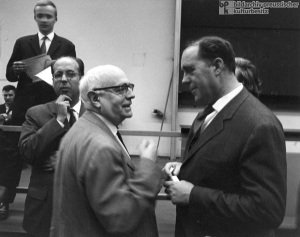
Correspondence on the German Student Movement Theodor Adorno/Herbert Marcuse Prof. Dr. Theodor W. Adorno 6 Frankfurt am Main Kettenhofweg 123 14 February 1969 Dear Herbert I wrote to you on 24 January and enclosed for the dean of your faculty an official English invitation from the Institute. Since I have still not received a response, I am rather afraid that, due to some sort of catastrophe—be it natural or social—the letter has gone astray. I am requesting a rapid response, in case I need to send you carbon copies.By the way, I committed an error of form: an invitation from the Institute can de jure only originate from Friedeburg, Gunzert or me, but not Habermas. Though he is the co-director of the sociology department, he is not formally part of the Institute; and the two things must be kept separate from each other in organizational terms. I need not say that the invitation met with Jürgen’s full approval. Things have been terrible again here. A SDS group led by Krahl occupied a room in the Institute and refused to leave, despite three requests. We had to call the police, who then arrested all those who they found in the room; the situation is dreadful in itself, but Friedeburg, Habermas and I were there, as it happened, and were able to guard against the use of physical force. Now there is a whole lot of lamentation, even though Krahl only organized the whole stunt in order to get taken into custody, and thereby hold together the disintegrating Frankfurt SDS group—which he has indeed achieved in the meantime. The propaganda is presenting things entirely back to front, as if it were we who grasped at repressive measures, and not the students who yelled at us that we should shut our traps and say nothing about what happened. This is just to put you in the picture, in case rumours and rather colourful accounts should filter through to you. In spite of everything, my book is progressing quite well; I almost feel like saying unfortunately, because the events leave me quite unmoved in a way that I can hardly explain to myself. I do not even feel the fear to which I am entitled. On the other hand, the intensity with which I am throwing myself into my work may be steeling me a little bit. I hope to get far enough in the rest of the so-called vacation weeks that whatever remains to be done is of a more or less technical nature. I also want to let you know that Max has every intention of being here too on the same days as you. I am in quite good health, apart from a chronic lack of proper rest. And we survived the winter—which has taken on such a frightful form again in the last few days—without catching Hong Kong flu. Much love to you both—from Gretel too. Your old friend Theodor * * * 125 Herbert Marcuse Dept. of Philosophy University of California at San Diego 5 April 1969 Dear Teddy I find it really difficult to write this letter, but it has to be done and, in any case, it is better than covering up differences of opinion between the two of us. Since my last letter, the situation has changed decisively for me: for the first time, I have read more detailed reports about the events in Frankfurt, and I have also received a face-to-face report from a Frankfurt student who ‘was there’. Of course, I am aware of the attendant bias, but what came to light at no point contradicted what you wrote to me. It simply expanded it. In short; I believe that if I accept the Institute’s invitation without also speaking to the students, I will identify myself with (or I will be identified with) a position that I do not share politically. To put it brutally: if the alternative is the police or left-wing students, then I am with the students—with one crucial exception, namely, if my life is threatened or if violence is threatened against my person and my friends, and that threat is a serious one. Occupation of rooms (apart from my own apartment) without such a threat of violence would not be a reason for me to call the police. I would have left them sitting there and left it to somebody else to call the police. I still believe that our cause (which is not only ours) is better taken up by the rebellious students than by the police, and, here in California, that is demonstrated to me almost daily (and not only in California). And I would even take on board a disruption of ‘business as usual’, if the conflict is serious enough for that. You know me well enough to know that I reject the unmediated translation of theory into praxis just as emphatically as you do. But I do believe that there are situations, moments, in which theory is pushed on further by praxis—situations and moments in which theory that is kept separate from praxis becomes untrue to itself. We cannot abolish from the world the fact that these students are influenced by us (and certainly not least byyou)—I am proud of that and am willing to come to terms with patricide, even though it hurts sometimes. And the means that they use in order to translate theory into activity?? We know (and they know) that the situation is not a revolutionary one, not even a prerevolutionary one. But this same situation is so terrible, so suffocating and demeaning, that rebellion against it forces a biological, physiological reaction: one can bear it no longer, one is suffocating and one has to let some air in. And this fresh air is not that of a ‘left fascism’ (contradictio in adjecto!). It is the air that we (at least I) also want to breathe some day, and it is certainly not the air of the establishment. I discuss things
Sexuality, Identity and Censorship

Charu Gupta What I am going to say is nothing new. While exploring the linkages between sexuality, identity and censorship, I want to talk about certain key elements, which reveal the intersection of the three. There are multiple sites of censorship, which of course is done by the State over and above all, but there is explicit and implicit censorship done in India by dominant castes, majority communities and patriarchies. I am interested here in this kind of censorship, which is done to silence and marginalize alternate sexualities, ambiguous religious identities, sex workers, certain languages, people, symbols and culture. Such censorship of sexuality has historical roots. My examples come largely from a colonial context and from contemporary India, exploring how sexuality becomes a key arena for the imposition of censorship by the moralist Hindu brigade particularly, in literary genres, print and visual media, and in actual practices. I would also like to ponder how identity politics, in a manner, contributes to a different kind of censorship. I want argue that in the construction of a homogenous Hindu community identity, which operates and works through a reworked and updated patriarchy, censorship becomes a critical tool, as it helps to control sexualities on the one hand and impose a fixed identity on the other. In fact escalation of sexually repressive censorship is intricately tied to heightened assertion of a Hindu community identity. The pogrom in Gujarat has brought home to us how implicit censorship imposed by dominant religious communities and castes operates in tandem with State censorship. The influential work of Michel Foucault has revealed how propagation of disciplinary regimes requires an intensification in the management and policing of sexuality, which further leads to distinctions of identity. It has been also asserted that obscenity also emerged as a distinct regulatory category in the modern period, and was subject to intense censorship particularly in Europe, in part due to the rise of literacy, the spread of print and a wider dissemination of written texts, and in part due to Victorian notions of chastity. Combined with this of course, this debate has extended to pornography. Sharp lines have been drawn between anti-pornography and anti-censorship feminists in the West. Catherine MacKinnon in her powerful critique of pornography claims that it institutionalises the sexuality of male supremacy, fusing the eroticism of domination and submission with the social construction of male and female. However, feminists like Judith Butler question the pervasive power of pornography. She builds a case for performative contradiction, whereby utterances cannot be assigned a consensus of meanings. Divisions often made between legitimate erotic art on the one hand and obscene pornography on the other, where the latter is subject to censorship, have been attacked, linking it to debates on high and low culture. It has also been pointed out that distinctions need to be made between sexually explicit representations and sexism. Consensual and coercive sex cannot be collapsed. Some even say that pornography actually reflects male anxieties and fears. Moreover, it is argued that while women are victims of violent crimes, the persistent foregrounding of pain and political correctness marginalises women’s sexual pleasures and desires. In India, feminists have pointed out that there has broadly been a ‘conspiracy of silence’, combined with censorship, regarding sexuality. In recent years examples of such censorship abound, be it the attack on songs like ‘choli ke peeche’ or M.F. Hussain painting Saraswati or the withdrawal of the 1997 Delhi Tourism Diary due to the protest by BJP for the inclusion of a representation of the bronze statue of the nude Yakshini or ‘Dancing Girl’ from Mohenjo-daro. There is a long history of such censorship, and in the colonial period particularly, moral and sexual worries of the British combined with those of an aspiring indigenous Hindu middle class. There was a moral panic of sorts that gripped a section of the British and the Hindu middle classes, creating anxieties regarding questions of sexuality, which was reflected in various arenas. Implicit and explicit censorship was used here for a coercive and symbolic regulation of women, which helped in replenishing colonial authority, updating indigenous patriarchy, and proclaiming a collective identity. In north India for example, there were endeavours made particularly by the Hindu publicists to redefine, control and censor literature, entertainment and domestic arena, especially pertaining to women, to forge an empowering Hindu identity. The discursive management and control over sexuality was essential to project a civilised and vibrant sectarian Hindu identity. Regulation and censorship of sexuality thus was, and continues to be, central to identity politics, be it fundamentalist, racial or nationalist. It is needed in order to control women, justify domination and subordination, and uphold community honour. However, sexuality, pleasure and love have been expressed in diverse ways. Through various mediums women and men have found ways to undermine implicit assumptions about gender systems and to negotiate codified sexual relations. We have a rich variety of experiences and practices, which are indifferent to and sometimes even subvert the tyrannies of respectability and standardisation. Such transgressions have precluded the crafting of a master narrative, and ‘disorder’ has crept into the ‘moral order’ of the censorship brigade. In dominant narratives of love and sexuality, monogamous, heterosexual, same community/caste marriages and relationships continue to be the predominant ideal. In colonial period too same-sex attractions or inter-religious love represented a dangerous breach to nationalist ideals and Hindu community assertions. Deviance from ‘normal’ codes of behaviour revealed the possibility of diversion from the accepted and the expected. I want to first explore a book written in this period on male-male sexual bonding, which became a major target of attack by the Hindu publicists and faced severe censorship and condemnation. This was a period when efforts were being made at linguistic standardisation of Hindi, combined with attacks on any hints of eroticism and obscenity in Hindi literature, which were seen as hallmarks of a decadent, feminine and uncivilised culture. There was a growing fear of romance, of sexual and bodily pleasure, seen as a transgression