
Theatre, Number, Event: A Second Appraisal
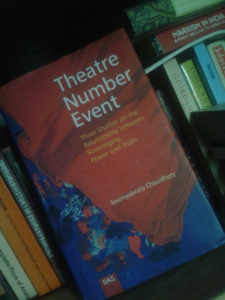
Prathama Banerjee [ HUG reproduces a second appraisal and an early critique of Soumyabrata Choudhury’s newly published book Theatre, Number, Event: Three Studies on the Relationship between Sovereignty, Power and Truth, IIAS, Delhi, 2013. The writer was a panelist in the recently organised session at C.S.D.S. , New Delhi on the occasion of the release of the book. This is the concluding essay in this series.] ———————————————————— Soumya is a very old friend from my university days, and it is a special feeling to be discussing his book. In that it is indeed a discussion rather than a comprehensive review of the book, and I do not even claim to do justice to the book’s ambitious narrative and unusual analytic frame. Soumya is an extraordinary mind. He is a philosopher, a literature student, a performer, a director of plays, a teacher and now I see also a historian. The book, therefore, like he himself, is a challenge for any friend and comrade, who like me shares his passion for politics and philosophy, but thinks very differently, perhaps even incommensurably. What I shall say by way of discussing the book is then a kind of response to this intimate challenge that Soumya poses before me. First, let me present briefly how I read Soumya’s book. The book is about sovereignty – sovereignty as simultaneously political sovereignty and sovereignty of thought, sovereignty as that of philosophy on the one hand and on the other, of the king/Christ/state and eventually of that impossible, uncountable entity, namely the people. Soumya works through a series of historical moments, though not chronologically (something to which we shall come back later) – 5th century BC Greece with its theatre and its civic assemblies of gods, citizens, faceless slaves and women, 12th century Europe with its notion of Christian theological kingship, 8th-9th century Byzantium with its controversy regarding the question of the icon and the idol and the worship and circulation of the same, 18th century France with its revolution, terror and increasingly medicalised madness, and finally the contemporary with its war on terror and its democratic revolutions. Soumya’s project is to tease out histories of the constitution of sovereign power in this long story of Europe (and he shall argue the world). Soumya implies that the history of sovereignty is produced at two levels – one, as the story of the sovereign as a figure and two, as the question of the ground, the basis, the founding principles of sovereignty. The figures of sovereignty as they appear in history, and yet fail to acquire full presence and stability (which is what the whole story is about), are the Greek gods with their strategic intelligence and liturgical role, the consecrated Christian king backed by the notion of eucharist transformation that transubstantiates the inscrutable idea of divinity into flesh, and the post-revolutionary republican people, counted as a disassembled numerical order of populations and while being mobilized as the One, the singular Nation. The ground of sovereignty on its part appears in two senses. One as jurisdiction – of law, administration and taxation – that appear through history as fisc and empire and patrie, in different ways assigning a territoriality, a world-extension to sovereignty itself. The ground also appears as the ground of thinking the power of the universal, which in the history of Europe appear as philosophy and theology and in modern times, mathematics. Through what Soumya calls a ‘commensuration’ of the figure and the ground, the book goes on to show that the ground of thought is also the ground of sovereignty, the ground which underpins the exercise of both power and truth. Soumya’s story is full of fascinating moments – as when he demonstrates that the imperative of governmentality is as old as and indeed part of the imperative of sovereignty; or when he lays out the long history of tithes and taxes in Europe as a dialectic between the debt to and debt of the sovereign; or when he excavates an older history of the economy as a domain of regulation mapped by the circulation of Christian icons, making the economy into God’s worldly plan for the salvation of mankind. We do not have time here to dwell on these details, though each of these by itself can be major point of discussion. I shall only mention here that in Soumya’s imagination, all these discrete moments make up what he calls an ‘inconsistent’ history of sovereign power, i.e. a history without unity or necessity. This means, in my understanding, that no straight-forward chronological or successional history is possible for sovereignty, precisely because the career of sovereignty is also repeatedly a history of its siege, its failure, its dysfunctionality – the manifestation of the groundlessness, the voiding of sovereignty, despite its cunning, its ruses and indeed its claim to truths. In that sense, despite its historicity, sovereignty, at different times must be set up anew, following its own failure. The place of the French Revolution in the book is precisely to show up such a moment of the failure of sovereign power and of the difficult search for a new ground and a new figure of sovereignty, namely the people. As Soumya shows through his reading of Michelet’s history of the French revolution, it is not as if forms of sovereignty, power and truth make successive paradigm shifts in a long history of political society, but that everything must be recommenced, the present reinvented every time, by rewriting once again its past and its future, following upon the defaulting of an earlier form of sovereign presence. Soumya’s account of the career of sovereignty is persuasive in its own terms, but in my eyes, the account comes up against a critical unresolved question – namely, the question of the relationship between history and philosophy. Soumya imagines this relationship as a kind mismatch – sometimes there is the glimpse of geological metaphors, a faultine, an abyss – between the metaphysics of truth and the structure of possible actualisations of power, between the philosophical
Theatre, Number, Event : An Appraisal

Saitya Brata Das [The writer was one of the discussants in a recently organized session at C.S.D.S. , New Delhi, on the occasion of the release of Soumyabrata Choudhury’s book—Theatre, Number, Event: Three Studies on the Relationship between Sovereignty, Power and Truth. Here is the text that the writer has shared with HUG] I feel honoured to be here today on this occasion of the book launch of Soumyabrata Choudhury’s much awaited book Theatre, Number, Event: Three Essays on the Relationship between Sovereignty, Power and Truth. The book is much awaited, especially for his privileged friends like me, friends who know that Soumyabrata has been working on a book for a long time. Some of us , and I am one among this “ us” , are fortunate enough to have had glimpses into the book in the process of its gestation and unfolding, a process from which certain “violence” is inseparable albeit a creative violence it is. Such violence seems to be inseparable from a book like this, given the formidable ambition and accomplishment of it, as we will be able to see now properly in the light of its publication. Such violence is audible in the very language of the work that does not welcome us immediately and the reader has to think a lot to decide whether she should pick up the book to read at all, not out of disrespect but precisely out of a profound respect, respect that we know to be a certain experience of distance or withdrawal. Such an “unattractive” or rather “attractive” quality of the book can be disadvantage only if the book does not have such formidable ambition and is thus impatient in soliciting the reader’s immediate attention and instant gratification. Sometimes such “indigestibility” or “unattractive” character proves to be good for the health of a work, especially if it merits serious attention from the reader who wants to read in a responsible manner. Given the formidable character of the book that takes the reader into a labyrinth that seems to have a secret password connecting so many paths and counter paths, lanes and by-lanes and thereby weaving an intricate network of concepts, spaces, and times, it is impossible for me to talk about the book in a comprehensible manner. Moreover, one should leave the reader to the risk of the book, the kind of risk, or “wager”- a word that Soumyabrata is in love with – wager that book itself assumes. I should therefore let each reader to judge her/himself whether such a risk that the book undertakes is at all worth taking and whether the researcher has succeeded or failed in his attempt. I will just speak, within some minutes of clock-time, of one of the problems that book raises in a manner of a glimpse or in the blink of an eye. Obviously, it is going to be insufficient and even, perhaps, unworthy of me since I do different things, and raise some different problems in my works. So I will take up one problem, the problem with which the books begins, the problem that I am somehow more interested and little-bit more connected, which is: the problem or rather the scandal of “sovereignty” and the question of the political-theology. The question that Soumyabrata appears to me to have raised is not so much to ask: ‘what is sovereignty or even, who is the “sovereign” so as to arrive at the “axiomatic” understanding of sovereignty or at the concept of the “political” as such.In fact, a good deal of the book is devoted to the even more preliminary discussion of the “axiomatic”, bringing out carefully the precarious or fragility that adheres in the “axiomatic” as such, the poros or the aporetic that ties and unties its claims to the status of the “immemorial”. The book rather raises the following uneasy question: ‘why is it that, and in what manner is it at all that the concepts/figures/modes of sovereignty assume the status of the “axiomatic” in such a way from which a certain claim of the “immemorial” is inseparable?’ Now this assumption of sovereignty and this intrigue of relation between sovereignty, axiomatic and immemorial itself, while being structural, is also historically variable, not just in a quantitative manner but in a manner of qualitative discontinuities. Thus from the liturgical foundation of sovereignty to the later Christus-Fiscus parallelism that justifies sovereignty, there is a discontinuity, in fact a violence that Soumyabrata delineates carefully with the help of Ernst Kantorowicz in a manner that will surely evoke much admiration for the reader. To answer the question he asks, Soumyabrata traces out a history or perhaps better, a genealogy of apparatuses of inter-linking practices and discourses alike by means of three interlinking fictions of concepts – “theatre”, “number”, “event” – to reveal the thread that tie and untie the “axiomatic” to the “sovereignty” and “sovereignty” in turn to the “immemorial”. It appears here as if the porosity or fragility of the one immediately brings porosity to the others: the porosity and aporetic binding or unbinding of the axiomatic claims of sovereignty to the immemorial. Soumyabrata conceives that it is the philosophical task par excellence, the task of this strange discourse called “philosophy” – here I don’t go too far with what he understands by “philosophy” – to envisage, or better welcome the “new immemorials” that are eventive, aleatory and ever new contingent eruption that breaks into the historical continuum of the world. Here and this now of this “breaking into” is the place of the “new”, a space without a pre-given parameter of measurement and a time without pre-given measure of numbers. Such a possibility of thinking, for Soumyabrata, is given by a strange mathematics, now released from a dominant version of the “mathematizable” in the sense of the countable mathematics of number, a “contingent” or “situational” mathematics if at all one can use these words, mathematics that is not alien to “the logic of multiplicity” that constitutes and potentially
Violence, Innocence, Opportunism

K. Balagopal The public arena is witness to dispirited discussion of the ineffectiveness of people’s movements, which are at the most able to slow down things, and nothing more. The discussion often turns around violence and non-violence, not as moral alternatives but as strategic options. Those who are sick of sitting on dharna after dharna to no effect are looking with some envy at violent options, while many who have come out of armed groups find the Narmada Bachao Andolan (NBA) fascinating. It is good that there is some openness in the matter now, for dogmatic attitudes have done considerable harm. To say that one should not be dogmatic about violence may be morally a little unsettling but it is a defensible position even without adopting a relativistic attitude towards the preciousness of life or a casual attitude towards one’s moral responsibility for injury caused in the course of a struggle. More of that in the right context. But the discussion will unavoidably be based on assessments of the effectiveness of the alternatives, and a distant view is likely to colour the reality with hopes and assumptions, even illusions. A realistic assessment of what each strategy has been able to achieve would better inform the debate. The plain and stark fact is that while all strategies have been effective in curbing some injustice, none has succeeded in forcing the government to take back a single major policy in any sphere. And none has been able to reverse the trends inherent in the structures of society and economy. Yet no serious political movement or social struggle we know of is only for softening oppression or improving relief. The general understanding is that governance of the country – and may be the systemic infrastructure of society – is fundamentally wrong and needs remedying, maybe overturning. Do we know of any effective strategy for that? I am not talking of political strategies, but strategies of struggle that will successfully put pressure upon the State and the polity to stop them in their tracks. The struggle may be built around class or caste or any other social combination. It may in the end seek reform or the upturning of the polity. It may operate mainly or in part within the polity or keep out of it altogether. Whichever it is, the common problem is this: the experience of this country is that governments do not stop doing some thing merely because it has been demonstrated to be bad. Or even contrary to constitutional directives and goals. They stop only if going along is made difficult to the point of near impossibility. No democratic dispensation should be thus, but Indian democracy is thus. Short of that, you demonstrate the truth of your critique till you are blue in the face or shout till you are hoarse in the throat, it is all the same. This is the question that haunts all movements, and none has an answer. All strategies, whether violent or peaceful, have found that they are not without success, if by success is meant stemming of local forces of oppression or the local manifestation of global forces, and improving the situation of its victims at the margin or even more. One does not wish to belittle these achievements, and in any case its beneficiaries are grateful, and belittling makes no difference to them. But any attempt to go beyond that has been faced with an insuperable wall which defines the limits of Indian democracy. The naxalites – in particular the largest of them, the Maoists – are generally credited with having used strategies of violent struggle to great effect. That they have had substantial effect on the local social and political structures is beyond doubt. From Telangana to Bihar, local society would not be what it is but for their effect in turning much of it upside down. That they have often acted as a very effective deterrent to knavery and charlatanry of all kinds too is true. But looking back on nearly forty years of the naxalite movement, one is surprised how few are the important policy decisions of the State or tendencies inherent in the logic of unequal development that the naxalites have been able to stall. In fact, one cannot off-hand think of even one. They themselves may answer that it is because they have not tried. It is true that their strategic thinking does not turn around defeating the State politically but mobilizing against it militarily. Hence inflicting major political defeats or reversing trends of unequal or destructive development is not on their agenda. Yet it is also true that even if they tried they would not know how to go about stalling such decisions or forces. To put it simply, you can hold a gun to a landlord’s head but Special Economic Zones or the Indo-US Nuclear Deal have no head to put a gun to. This degree of simplification of the issue may be criticized as unfair, and one would readily agree that Maoist violence is not just the armed action of individual Robinhoods. Nevertheless, after dressing up this skeleton with sufficient flesh and blood to make it real, you still do not get away from the basic truth of the caricature. It is not just the abstractness of these issues that makes violence ineffective as an option against them. After all they do have concrete manifestations that can be confronted by violent mobilisation or armed action. But the subtlety of forms of power other than the feudal makes focused confrontation of a violent kind difficult to operationalise. Violence may be good or bad, necessary or unnecessary, but it is always crude. Intelligent exercise of power, on the other hand, is subtle. So is capitalist rationality, in general. It is sometimes but not always crudely oppressive. It also comes with promises of a better life for the middle classes and employment for the poor. It spreads its operational incidents all over and each of them offers
Earth: A Wandering

Alfred Kentigern Siewers Earth is at once both symbol and reality: both a planet with a proper name and a substance, humus, from which the human emerges in participation, along with many of our fellow travelers in the physical world – animals, plants, and others. It is thus also both a wandering and a grounding – and most of all, perhaps, a wondering, at what environmental philosopher Bruce Foltz in a new study of the ongoing life of noetic Christian tradition in environmentalism calls ‘the heavenly beauty of Earth’ (Foltz, 2012). Pre-moderns and non-moderns probably lived and articulated this more particularly than moderns do with our more abstract GreenSpeak. But we all experience the conjunction of meanings of earth at some level. The modern West often expresses it through a type of post-medieval understanding that re-centers us in a medieval middle on Earth, part of the original impetus behind Romanticism. Whether it’s J.R.R. Tolkien’s association of his retro-medieval Shire with Appalachia (Davenport, 1997); the medievalism enabled by a cyberspace that simultaneously removes us from the Earth and enables us to engage different time periods and cultures more simultaneously: or personal traditions that re-form community with Earth, as we weave them from our scholarship through the interstices of our academic lives or arts: we connect with actual people and physical environments on Earth and in earth as both refugees from the modern and ambassadors to it, enmeshed in that which we seek to proclaim. *** As I walk through a last remnant of old-growth forest in Pennsylvania looking for our annual church Fourth of July picnic, passing through shady groves of hemlock trees amid brooks habited by bears, Amish teenagers, and, in earlier days, the nature writer Euell ‘ever eat a pine tree?’ Gibbons, I am reminded of the retro-medieval Forest of Arden. In Shakespeare’s As You Like It, the usurper duke’s wrestler Charles asks the dispossessed and out-of-favor Orlando, ‘Come, where is the young gallant that is so desirous to lie with his mother earth?’ (Shakespeare, 1992, 1.2.296). But Orlando is thrown to earth in a different way than the duke and wrestler envision. He flees the court for Arden. There he begins carving love poems to Rosalind on trees, in a ‘green world’ in which, as the duke-in-exile remarks, human life ‘exempt from public haunt finds tongues in trees, books in the running brooks, sermons in stones, and good in everything’ (2.1.299). Arden, a disappearing forest in the Warwickshire precincts of Stratford-on-Avon, itself becomes a kind of sylvan haunt in the play, written during the time of the Enclosure movement. Such remnant woods around England had become places where an outlaw forest economy found temporary refuge, while an expanding British Empire cut them down for ships, privatized pasturage, and witnessed a new pastoralism. Phantoms of the Middle Ages like Robin Hood haunted such woods, while vanishing into Elizabethan stories. These forests of the imagination exemplified C.S. Lewis’ curmudgeonly remark while giving birth to his Oxford History of English Literature tome (a painful project he labeled by acronym ‘the oh hell’) that England had no Renaissance because of its insular medieval continuities (Lewis, 1954, 55–56; Coghill, 1965, 60–61). Yet in Arden’s ‘green world’ of imagination, the denizens of Shakespeare’s forest (a locality confusable in name also with both Ardennes woods in France and biblical Eden) find empathy not only for crying deer, but for each other, ending in a metonymy of marriage rites as well as a crossing of the human and non-human. What the exiled duke calls ‘this wide and universal theater’ (Shakespeare, 1992, 2.7.135) of Arden becomes in its engagement of the non-human, a place of experience of earth apart from the human conventions of the court. In its back-and-forth focus between the ‘green world’ and human society, Arden comes to typify what environmental philosophers (glossing Heidegger) distinguish as earth differentiated from the world of human cultural constructions: ‘The other side of nature,’ the phusis that simultaneously both hides and discloses itself. Yet earth spans the real if ghostly Arden of Warwickshire, as well as the type of older ‘green world’ associations of English folklore identified by the critic Northrop Frye (Frye, 1949), rooted in both the mythological ‘Celtic’ Otherworld and the transplanted Desert of early Christian monasticism. *** The integration of the real, imaginary, and symbolic in this mysterious sense of earth echoes the American Pragmatist Charles Peirce’s pioneering work in ecosemiotics. In Peirce’s model, the process of semiosis, or meaning-making (for him a definition of life), could involve a nature-text, an outward-facing triad of sign, environment and meaningful landscape, beyond de Saussure’s more arbitrary and internalized binary of signified and signifier (Maran, 2007). Landscape, as a meaningful symbolic overlay of earth, thus integrated the contexts of reader and author, while relating them directly to text and physical environment. The earth itself then reads as a nature-text, but always beyond our full comprehension, since we ourselves are allegory in the text. Arden’s ecosemiotics of ‘tongues in trees, books in the running brooks, / sermons in stones, and good in everything’ thus provides context, grounding, and redefinition for Jaques’ famous notion in the play that ‘all the world’s a stage, and all the men and women, merely players’ (Shakespeare, 1992, 2.1.16–17; 2.7.305). Linking that stage to a physical environment offers earth to Orlando not only as ground of humiliation, and not just Jaques’ placeless theater, but as experience of place leading to what deep ecology terms self-realization in the environment of earth. Deleuzean terms take it further into a rhizomic realization. And pre-modern Christian traditions literally and figuratively offer us a vision of the cross between the immanent and the transcendent, the anthropomorphic and the cosmic. *** When the Apollo 8 astronauts looked back on our planet from lunar orbit in 1968 and recited the Creation account from Genesis, they offered perhaps the most famous attempt to subsume ancient traditions of earth into the world of modern technology. But their words still evoked a pre-modern sense of our planet as mystery: ‘In