
Why Classics?

Utpal Dutt Snobs have always been contemptuous (over their morning cups of coffee, if you please) of the non-professional theatre groups in the city who are modestly building up a movement. Slogan-mongering, puerile, Communist, un-Indian—they have used many such odd epithets. So far, perhaps, they have had a ground—we have been busy too long making theatre a living newspaper and we had reasons for it. But we have also been guilty of neglecting the past, of scoffing at it with silly phrases borrowed from our smattering of Left literature. But now we can throw down the gauntlet. One group is rescuing Tagore from the emasculating chauvism of Santiniketan; another is rediscovering forgotten classics of the nineteenth century; a third bringing you Shudraka’s masterpiece. The classics belong to us and we alone can interpret them for the modern audience. Shorn of the classics, a modern repertoire becomes shorn of tradition, rootless and empty. For, the greatest experiment consists in carrying tradition forward, not in denying it; in interpreting and moulding it for our epoch, not in rejecting it as old. Moreover, the classics give us elemental noble passions that are wanting in contemporary drama. As Robert Jones once said in disgust, “Modern drama has been reduced to conversation about whether egg is hard-boiled or not.” There is a tendency in the name of revivalism to compress the emotions of men and women into the trivialities of breakfast and dinner. The dramatists are busy imitating probable conversation: what would such a character caught in such a situation say if he were real? The result—not even a fraction of complex modern life finds expression in theatre. Life is not just conversation and behaviour, but thought, emotion, passion. Desperate attempts have been made all over the world to capture on stage these other great aspects of life. Tagore heightened his drama from the real to the allegorical. Toller poetized the struggle of the working class. O’Neill’s Strange Interlude (1928) introduces inner voices of the characters. Brecht tried the epic style with modern themes. Eliot wrote Shakespearean verse about cocktail parties. But most of this expressionist and poetic drama has failed; it has become mere jugglery with forms. It has not the simplicity of the classics. Why is this so? Because theatre has abandoned its conventions. There was a time when the theatre was all convention. The Chorus introduced the play; the king’s chariot was imaginary; Vasantasena’s lavish villa was described purely through the spoken word; so was Cleopatra’s voyage down the Nile, and the death of Ophelia. There was a time when the actor soliloquized and gave us a glimpse into his soul and not only into his behaviour. What after all is the value of the opera-bouffeish murder of Duncan without the beautiful revelation of a man’s soul in ‘Is this a dagger?’ speech? Hamlet would be a typical Renaissance melodrama of intrigue, murder, ghost, duel, suicide and four corpses to bring the curtain down, except for the soliloquies, the conflicts within a thinker, his struggles with himself, which tone down the horror and give the frantic incidents a new meaning. The Chinese tragedian entered the stage and immediately introduced himself and his problems to the audiences. The Japanese stage manager in black freely walked around on the stage, prompting and helping the actors. But in 1840 a man called David Hill invented the photograph, and soon after, the disease of realism gripped the theatre in Europe. And now the Bengali theatre has caught it too. In this country of picturesque gesture and musical language, the dramatists are busy limiting the actor to the appearances of life, immobility and prosaic how-do-do’s. Would you believe this is the country where the Jatra developed—Jatra, which relies entirely on blank verse and sweeping gesture? Would you believe that Girish Ghosh wrote his Pandab Gaurab (The Glory of the Pandavas, 1900) and Kshirodeprasad his Bhishma (1913)? The playwright today is afraid to philosophize, whereas his predecessor could dare to write in dramatic form a full-fledged treatise on the essential loneliness of man, to express through Bhishma the philosophy of individualism. Thus, the classics teach us to heighten events from merely a photograph to a full painted canvas. They recapture for us the language of theatre. They show us the methods whereby we may so handle a modern theme that will surprise with a fine excess; it will awe, astound, ennoble. Behind the humdrum incidents of daily life, it will capture the soul of man. —————————————————— adminhumanitiesunderground.org
Creating Beauty Is A Noiseless Battle

Joy Goswami It has been the polestar of Bangla poetry: Phire Esho Chaka (Come Back, O Wheel)/ To Gayatri. And the original manuscript lies right in front me at this moment. Like Kafka’s diary, there are descriptions of a few dream sequences in the manuscript. The collection has elicited all kinds of praise and reverence in the last 40 odd years. What can I say that is new? But as I see the jottings and scribbles in the marginalia, I feel that I am right there with the poet as he gives shape to those lines. Goosebumps. Binoy Majumdar, the poet, seems to be a riddle, an enigma in the firmament of Bangla poetry. How do we see a poet today? We see him as a social explicator, as a critic, even as a reformer. The poet is routinely offered sundry platforms, chairs and silken shawls. Though troubled by some initial hesitation, the poet gets used to such a role as days go by. When the society is mired in violence, corruption and skulduggery and cannot see any light, sensitive, art loving people cannot rely on politicians and standard do-gooders any more. The kind of doubts they are assailed by, the kind of interrogations that arise in their minds, who else but a poet can satisfactorily answer them! Why? Since the poet is pained by the sorrows of others. Come, let’s all pay a visit to the poet. And then a collective voice cries out: Please say something. Please. And in this manner a group of uncertain, wandering people reach the poet and gradually push him towards the wall. As he is shoved right to the wall, a stool is advanced to him. And then the collective voice again: Get up on that stool, please stand up. We cannot see you, cannot hear you clearly. Here, a hand-mike, please use this. The poet—since everyone is so eager and expecting, relinquishes his vacillation, and starts speaking. And as he speaks, all his indecisions and waverings tend to recede by and by, till they vanish altogether. Television screens, literary festivals, protest meetings—all become regular events in his life, part of his existence. In such a life one speaks more than one writes. And when one speaks, one gets to believe that he is speaking to the whole of his community—for the Jati. The sensitive, common people are allayed of their apprehension of darkness engulfing them. Finally, there is someone who can speak on their behalf. A few can, at least. Every single time society witnesses a fresh accident, an incendiary poem would appear. Poem? Or opinion. Do we have time to ponder on that distinction? Here is our true poet. This is what art is supposed to perform. Be a conduit in protests, a vehicle in rallies. Its sole function. Sole function, and in such a manner? And what about that poet who is himself lost, seeking direction in every turn? The one who discovers the world anew every single day and feels that he did get to learn something novel. There is a possibility that yesterday’s mistake could be corrected today. And therefore, jots down one’s everyday experience and encounters in a meticulously drawn diary. Yes, as poetry. Unadulterated poetry. Do they have no right to create art, those who are unable to directly recommend that society must take such and such bearing or make this or that pitch? What role is left for such poets? If Binoy is placed aloft that stool, one is certain that he will hardly stay there for too long. He will fidget, feeling lost and suffocated. And then he will simply walk away. If we see that Binoy has been pressed on to that wall by an expectant mob, he will be too absorbed with his surroundings to pass any judgement. Perhaps he will turn around and face the wall instead. And then? —-See this wall, do you? There is something going on within it. —-Something? What do you mean? —-May be a rivulet is meandering across and some scenes are unfolding. Disturbing scenes. All lie there within this wall. Latent. You just need the eye to behold. This is exactly the exchange that Binoy is having with Balika Kankaboti even as he composes this timeless collection of poems. One recalls Bergman’s almost contemporary creation: Through a Glass Darkly, where a young woman’s intense gaze through an orifice in the wall will lead her into a magical realm where everyone is agog and waiting, everyone radiant in their expectation—for God might appear there at any moment. If someone sets his eyes on things differently and catches a glimpse of more than what we would usually notice (perspectives that we feel others should appreciate), we brand him as mentally unbalanced. Just like that woman in Through a Glass Darkly. What is Binoy able to see? He can see an ordinary, local grocery store. And walks past that store casually, freely. And then he relates that object and his relationship with that object to the whole of creation at a cosmic level. This local, ordinary grocery store is attached to the tiller in his field to the forces of gravity to the tireless sun to goddess Venus or Saraswati. In this magnificent, staggering cosmos, what more can a poet give, other than a series of flabbergasted moments of revelation, marvelling anew at every fresh object and seeking to forge relationships with those? But marvelling and revelation—are those sufficient? Can one write poetry with such a meagre capital in the world today? In a world where airplanes ram themselves into trade-centres, where tanks strut in Christ’s own town, where Gujarat happens in the next room—can one continue to write poetry latching on to wonder and surprise? Binoy Majumdar had to say this by way of prefacing this book: these adorations in love (through these poems) are an accurate journal and chronicle. But what shall we do with such loverly devotion? What can society gain by these ruminations?
Tagore: Looking Beyond the Mirage of Appearances
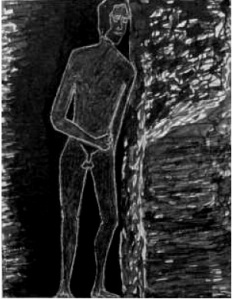
Rajdeep Konar [Rajdeep Konar is pursuing his doctoral studies in Center for Theatre and Performance Studies at the School of Arts and Aesthetics, Jawaharlal Nehru University, where he is investigating Rabindranath Tagore’s ideas on aesthetics, especially in the domain of performance.] “No man loves life like him that’s growing old.” -Sophocles, Acrisius [fragment] It is a fact that in the life of Rabindranath Tagore there has indeed been numerous instances of de-constructing and creating anew. But equating all that with his act of beginning painting at the age of sixty with the others, I think, would not be justified. It is one thing to re-write a play nine times, to change one’s views on matters of political or social concern even if one has believed in it for the greater part of his life and it’s yet another for a sexagenarian poet in Rabindranath Tagore’s position, to say that words no longer fascinate him and it is in a completely different artistic language: painting that he finds his calling. It definitely indicates towards an intense commotion underneath- a storm, which shakes the world of the poet, shakes his faith in the words which once in Budhadeb Bosu’s terms seemed his owned loyal subjects. I would like to direct my investigation, in this essay, towards this sudden loss of interest in words. Therefore, I would be trying to find out exactly what sort of circumstances would oblige Tagore, a compulsive writer by the sheer volume of his works, form an utter revulsion towards the vocation of writing, in the final phase of his life. This as we shall see, will lay bare an interesting negotiation that the old poet was going through with himself, at the time and also enlighten us regarding how he was reacting to the arrival of modernity in Bengali literature. “People grow older with every passing year; but the first half is what can be named growing while the second is withering away.”[i]These are the exact words with which writer and critic and Tagore enthusiast Budhadeb Bosu (1908-1974) begins his book “Shongo: Nishongota / Rabindranath” (1963). Budhadeb, when he was writing these words was already in his fifties and thus we can rest assured that he was speaking from more than intuition. He goes on to speak in the rather longish paragraph that follows about the perils old age has brought to his life: the fast diminishing physical and mental strength, blurring eyesight, deteriorating memory, the doubts and anxieties plaguing the mind faced with the smallest of decisions. All of this, as Budhadeb writes, affects him as a writer and makes writing, what was earlier pleasurable for him, an irksome and tiring process. We have also heard writers express similar sentiments under such circumstances. “An aged man is but a paltry thing, A tattered coat upon a stick”[ii] is what Yeats felt. American journalist and literary figure H. L. Mencken says “The older I grow, the more I distrust the familiar doctrine that age brings wisdom.”[iii] Thus, age we find weakens the physical constitution and makes oneself vulnerable, especially artists. So does Tagore too was similarly distraught by his diminishing physical and mental abilities? It does not seem likely at the time he begins painting in the early 1920’s. While there indeed were occasional illnesses, recurring problems like the pain he had in his knee, it was not until his mid or late 70’s that we get to hear from Tagore expressions like- “I no longer want to carry on the garland of pains that I am having to carry in this life”. For confirmation we can go to another Tagore enthusiast and philosopher Abu Syed Ayub who identifies Tagore as the possessor of a “poetic health”, stressing that even in his periods of grave illness Tagore’s poetic abilities remained unaffected[iv]. An allegation which Budhadeb Bosu makes in his work Kobi Rabindranath against Tagore and which might come to our aid here is that: the drama which is found developing through Tagore’s poetry beginning from Manasi ends in Gitanjali and after that Tagore only repeats himself and has not been able to write anything worthy of its creation. According to Budhadeb, specimens of whatever Tagore would write in his later poetry, was already available in Gitanjali. Even though Abu Sayeed Ayub in his work Adhunikota O Rabindranath dedicated to Budhadeb presents a surgical analysis of Tagore’s later poetry to dismiss any such notion; Sankha Ghosh shows in his essay Budhadeber Rabindranath how Budhadeb himself has contradicted his own view on a number of occasions. For instance the collection of poems titled Adhunik Bangla Kobita edited by him begins with Tagore’s post Gitanjali poems. There are definitely instances of poets or writers reaching a certain age and feeling that they have nothing new to say: Sudhnidranath Datta, a poet from the Kollol Jug in Bengali literature, who was also close to Tagore; for one lamented in his poems much before he was old “whatever was there to say, has been said long ago” while Bishnu Dey among the modern Bengali poets became tragically repetitive in his later years. However, whatever he may be called, the Tagore who writes Sesher Kobita, Shyamali or Sisutirtha, can never be called repetitive. So we are yet to find the true nature of the problem. We might go back from Tagore’s own words on the matter for some light. To Rani Chanda, who by her own admission was the most rigorous witness to Tagore painting, he says- “The bearer of beauty (rasa) is language. That is why the danger, thus everything changes with the change of language…so it often seems to me that my paintings would never be rejected because even if the specialty of lines and forms change, there would never be any dearth in their beauty.”[v] So was Tagore anxious that unlike his writings which may lose their popularity and acceptance with the change in linguistic trends his paintings would be acceptable beyond contexts of time and
Shibu Natesan : Animals, Magic Realism & Multiple-Realities

Siddharth Sivakumar [Siddharth Sivakumar is currently doing B.A. in English literature at Visva-Bharati, Santiniketan. He has an avid interest in art practices & art history and routinely writes for some of the leading art journals of India. He has edited two of the volumes of Bikshan Bulletin and is the co-founder and editor of Tinpahar–http://tinpahar.com] —————————- Why should one paint ? What should one paint and how should one paint ? These are basic questions that sooner or later cross the minds of young artists. It appears Shibu Natesan was never troubled by them. His paintings are a testimony of history through images. They march the same path frequented by great story tellers of our time. In the 80s as a student in the College of Fine Arts, Trivandrum, he was exposed to Latin American and African Literature through translations. Thereby he was well acquainted with the works of Latin American writers such as Gabriel García Márquez and Jorge Luis Borges, who proficiently juggled fact and fantasy. Later in his carrier this intermingling of the real and the unreal develops as a distinct character of his paintings. Like Rushdie’s Midnight’s Children, Natesan’s paintings map a certain history; making comments, sharing notes and expressing anguish in a language that shuttles to and fro between reality and the absurd alternatives of the real. The merging of fact with fiction, the smooth trespassing from the usual to the magical are the inherent qualities of Shibu’s canvas. Matthew Strecher defines magic realism simply as “what happens when a highly detailed, realistic setting is invaded by something too strange to believe”[i]. This undoubtedly is one of the notable aspects in Natesan’s works. The magic-realistic approach of his works, invaded by man, machine and animals crafted into a certain compositional marvel, goes beyond mere mediatic realism. The use of photographs or images form published media does not suggest a lack of imagination; rather the images from different sources provide yet another canvas upon which Shibu scripts his stories. The superseding layers constitute a new narrative, a narrative which would fail if not read together. Shibu Natesan’s works stand on firm ground communicating through its unique collage that weaves reality with the fantastic. The visual spectacle grows into a thought provoking exercise by creating moral conflicts that prompts one to explore social orders. The style adopted by Natesan suits and syncs well with his startlingly polemical works. But the very beauty of his art thrives on the apparent invisibility of that polemic. Natesan paints parables which narrate succinct stories, illustrating and illuminating certain universal values in an idiom made common by photography. The parables frequently involve characters at the verge of a moral dilemma, submitting to disputable decisions before culminating in some unpleasant consequences. The artistic language of Natesan is as transparent as the parables for children. There is a Blakean quality to his paintings in a manner of speaking. But the implications are less explicit and at times requires a closer scrutiny. In some of his paintings the presence of animals transforms the parables into fables. This active participation of the animals in the narrative structure happens to be a major feature of Natesan’s flights into phantasmagoria. His works present animals in a fashion so that they are easily identified with human beings. Borrowing Shibu Natesan’s own words, “Objectively for a painter painting human figures and animals are the same. The difference is in our association and meaning”[ii]. Often we find the flora and fauna voicing their disapproval of the hostile powers in an allegorical framework. Man’s domination over nature and the subsequent subjugation along with entrapment of those who rely on the nature, is a terrible reality of our time. Shibu uses his art to portray this uncanny reality. In his Street Charmer we find a young bear dancing to the music of the civilized world. And there are others that show how we utilize nature for our self-interest. Day of Wonder renders the awe a child and his mother share while witnessing sharks imprisoned in an aquatic zoo. The reality is depicted once again, but the stylistic treatment has undergone a drastic change. Paradoxically it is only with this setting-in of the photorealistic style that he begins to ruminate over the same themes and add other layers to it. A photograph by its definition captures a moment from the past. This momentary memory of a past reality corresponds to a lost time and space. In a world where nature is replaced rapidly with the un-natural, man-made entities, Captured Alive represents a scene dominated by nature. We find a set of lofty ducks paddling against a greenish ground with a half-visible grounded airplanes in the background. This brings about a change in Shibu’s perspective. The empowering scale of the ducks tend to establish a certain importance to their being. The newness of his style brings with it an alternative voice which is more optimistic while focusing on a stark issue. And Shibu soon realizes that the dynamics of time and space and the momentary reality of a situation should be challenged and altered. It is from this realization Shibu sets things in motion. Many of Natesan’s works are inspired by nature. These images often create a contrast by bringing animals and machines in the same frame, sharing proximity. The interaction between the binaries is characterized by the intertwined differences and similitude. Many-a-times flesh is threatened by the masculinity of the metal monsters. Nonetheless the message appears to be straightforward as it gets delivered. In his Untitled we find a cheetah standing upon a yellow Gallardo. The fastest animal on earth shares a stance with the speedy racing car. However the superficial similarity from the primary inspection wanes the moment we realize that there would always be a distinct difference between an inspirational cheetah and its inspired reflection, the natural and the artificial – something that the car-door bearing the blurred refection of the real tire testifies to. In his painting Against the Wind we find him making a similar point previously