
Cannibal Manifesto

Oswaldo de Andrade Cannibalism: An Introduction to “Cannibal Manifesto” The starting date for the Brazilian modernist movement, which advocated a return to the soil, is usually given as 1922, when the major impulse was given by the Week of Modern Art. This revolutionary approach was announced by a woman painter, Anita Malfatti, “the protomartyr of modernism,” whose forward-looking paintings in her second exhibition, in 1917, were derided by Monteiro Lobato (He claimed that she simply contributed her own “-ism” in her paintings where a horse and rider fall over: “I call this genre topple-ism”). But he himself had a great influence on Brazilian modernism’s most celebrated text, Oswald de Andrade’s “Cannibal Manifesto” of 1928. Also called the “Brazilwood Manifesto,” because it champions the use of native material and turns against artifice, this manifesto takes its name from the cannibalistic Tupi Indians of Brazil who disposed gastronomically of an unloved Bishop. It is outrageously satirical, reading in part: “Only cannibalism unites us… Tupi or not tupi, that is the question.” The manifesto shares the title of a Dada publication of two issues, Cannibale, whose lively primitivistic spirit is joined to the Russian Rayonists, with their Why-We-Paint-Our-Faces manifesto against the sophisticated and over-civilized society. Andrade’s preface to Seraphim Ponte Grande is another modernist manifesto that repudiates Modernism: “The Modernist Movement, culminating in anthropophagous measles, seemed to indicate an advanced phenomenon.” Elsewhere, he distinguishes between the two: “Simultaneity is the coexistence of things and events at a given moment.Polyphony is the simultaneous artistic union of two or more melodies which have the fleeting effect of clashing sounds as they contribute to a total final effect.” ————————————- Cannibal Manifesto Only Cannibalism unites us. Socially. Economically. Philosophically. The unique law of the world. The disguised expression of all individualisms, all collectivisms. Of all religions. Of all peace treaties.Tupi or not tupi that is the question. Against all catechisms. And against the mother of the Gracos. I am only interested in what’s not mine. The law of men. The law of the cannibal. We are tired of all those suspicious Catholic husbands in plays. Freud finished off the enigma of woman and the other recent psychological seers. What dominated over truth was clothing, an impermeable layer between the interior world and the exterior world. Reaction against people in clothes. The American cinema will tell us about this. Sons of the sun, mother of living creatures. Fiercely met and loved, with all the hypocrisy of longing: importation, exchange, and tourists. In the country of the big snake. It’s because we never had grammatical structures or collections of old vegetables. And we never knew urban from suburban, frontier country from continental. Lazy on the world map of Brazil. One participating consciousness, one religious rhythm. Against all the importers of canned conscience. For the palpable existence of life. And let Levy-Bruhl go study prelogical mentality. We want the Cariba Revolution. Bigger than the French Revolution. For the unification of all the efficient revolutions for the sake of human beings. Without us, Europe would not even have had its paltry declaration of the rights of men. The golden age proclaimed by America. The golden age. And all the girls. Filiation. The contact with the Brazilian Cariba Indians. Ou Villegaignon print terre. Montaigne. Natural man. Rousseau. From the French Revolution to Romanticism, to the Bolshevik Revolution, to the Surrealist Revolution and the technological barbarity of Keyserling. We’re moving right along. We were never baptized. We live with the right to be asleep. We had Christ born in Bahia. Or in Belem do Pata. But for ourselves, we never admitted the birth of logic. Against Father Vieira, the Priest. Who made our first loan, to get a commission. The illiterate king told him: put this on paper but without too much talk. So the loan was made. Brazilian sugar was accounted for. Father Vieira left the money in Portugal and just brought us the talk. The spirit refuses to conceive spirit without body. Anthropomorphism. Necessity of cannibalistic vaccine. For proper balance against the religions of the meridian. And exterior inquisitions. We can only be present to the hearing world. We had the right codification of vengeance. The codified science of Magic. Cannibalism. For the permanent transformation of taboo into totem. Against the reversible world and objectified ideas. Made into cadavers. The halt of dynamic thinking. The individual a victim of the system. Source of classic injustices. Of romantic injustices. And the forgetfulness of interior conquests. Screenplays. Screenplays. Screenplays. Screenplays. Screenplays. Screenplays. Screenplays. Cariba instinct. Death and life of hypotheses. From the equation I coming from the Cosmos to the axiom Cosmos coming from the I. Subsistence. Knowledge. Cannibalism. Against the vegetable elites. In communication with solitude. We were never baptized. We had the Carnival. The Indian dressed as a Senator of the Empire. Acting the part of Pitt. Or playing in the operas of Alencar with many good Portuguese feelings. We already had communism. We already had a surrealist language. The golden age. Catiti Catiti Imara Notia Notia Imara Ipeju* Magic and life. We had relations and distribution of fiscal property, moral property, and honorific property. And we knew how to transport mystery and death with the help of a few grammatical forms. I asked a man what was Right. He answered me that it was the assurance of the full exercise of possibilities. That man was called Galli Mathias. I ate him. The only place there is no determinism is where there is mystery. But what has that to do with us? Against the stories of men that begin in Cape Finisterre. The world without dates. Without rubrics. Without Napoleon. Without Caesar. The fixation of progress by means of catalogues and television sets. Only with machinery. And blood transfusions. Against antagonistic sublimations brought over in sailing ships. Against the truth of the poor missionaries, defined through the wisdom of a cannibal, the Viscount of Cairo – It is a lie repeated many times. But no crusaders came to us. They were fugitives from a civilization that we are eating up,
The Occupation of Art’s Labor: An Interview with Julia Bryan-Wilson
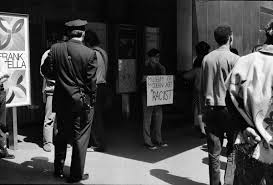
On November 28, 2011, Chris Mansour interviewed Julia Bryan-Wilson, Associate Professor of Modern and Contemporary Art at the University of California, Berkeley and the author of Art Workers: Radical Practice in the Vietnam War Era (2009). Mansour and Bryan-Wilson talked about the history of the Art Workers’ Coalition and its political relevance today, in light of the increasing involvement of artists and artistic strategies in the Occupy movement. What follows is an edited transcript. Art Workers’ Coalition (AWC) with the Art Action Group (GAAG), and the Black & Puerto Rican Emergency Cultural Coalition stiking outside the MoMA in 1970. —————————————————————————————- Chris Mansour: How did you come to study the artwork of what you call the “Vietnam War Era” and its relationship to the Art Workers’ Coalition (AWC)? Julia Bryan-Wilson: In the beginning—when I was still a young graduate student—I was drawn to a performance by the Guerrilla Art Action Group (GAAG) that occurred in the lobby of the Museum of Modern Art (MoMA) in 1969. It was a bloody, visceral action that called for the immediate resignation of all Rockefellers from MoMA’s Board of Trustees. At the time I was thinking about performance art as a form of protest, and how bodies in space—occupying space—meant to register certain activist concerns. Digging further into GAAG, I learned more about how they functioned as a direct action offshoot of the AWC. I wanted to do a project about the AWC, perhaps plumbing its history and laying out what really happened there, because there had at that point only been scattered accounts, and most of them were by people who were involved themselves, so there was not much critical distance. To me the AWC was a compelling, if short-lived, organization. I was also very intrigued by how many artists and well-known figures within the circle of contemporary art criticism participated in it. So it was not just people like Carl Andre and Dan Graham, but also critics such as Gregory Battcock, who was the editor of significant anthologies about “minimal art” and “idea art.” Some critics like Lucy Lippard and what were referred to as “low level curators” also saw themselves working within and amongst the AWC. But my focus shifted the further I delved into my research, and increasingly moved away from a strictly chronological account of the AWC towards larger questions of the politics of artistic labor in this moment, a moment when labor itself was radically transforming because of a shift to a postindustrial age. To me the intriguing question became not, “What happened to the AWC?” but rather, “How did understandings of artistic labor change in the wake of the formation of the AWC?” Also, how was artistic labor and broader political activism in mutual dialogue for a few key figures, such as Lippard or Hans Haacke? With my book, Art Workers, I never set out to write the comprehensive history of the AWC, but instead to think about the redefinition of artistic labor through figures that are very influential in contemporary art history, whose work has never been substantially talked about in relationship to this activism. CM: The main redefinition of artistic labor, as you elucidate in your book, starts with the distinct division between art and craft during the Renaissance era, as articulated by the art historian Michael Baxandall. But art as a form of labor really takes sway with the development of capitalism as a social structure. You reference a lot of Marx’s writings on art as labor in your book to make this case. You also mention the Artist Guild in England in the 1800s, the Artists Union in the 1930s, and so on. How did these diverse conceptualizations of art as a form of labor influence the AWC, and how do you see the AWC’s understanding of art as a form of labor as differing from older aesthetic concepts? JB-W: Those involved in the AWC had many different, and quite uneven, levels of sophistication regarding Marxist theory. Some of them knew nothing about Marxism, and were kind of going along with the flow or absorbing things that were ever-present in the atmosphere of the times. Others, like Carl Andre, were rather more serious students of Marxist theory. Of course, Marxist theories are also contentious and contradictory with regards to how art might or might not function as a kind of labor under capitalist forms of production. Even for Marx himself there is some friction regarding the role of patronage, creating a product for a potential market, and how making art might be understood as “free” or unalienated labor. So when artists turned to what was often half-understood Marxist theory in the late 1960s to call themselves workers, it proved to be fairly unstable ground. But the people in the AWC did have some historical precedents regarding the relationship of art and politics: They knew something about the Russian Constructivists, who called themselves “art workers.” They also knew a lot about the WPA moment and the Artists’ Union in New York, because some of those involved were still around. But the AWC was founded during a totally different cultural context than the Artists Union in the 1930s. The WPA employed artists under the rubric of a state sponsored program. Artists in the 1960s–70s were working with strongly anti-governmental precepts, and it was difficult to make the WPA type of artistic labor fit their vision, since that was, in their minds, akin to making Social Realist murals under the guidance of a corrupt state. Those in the AWC wanted to be free to make recalcitrant art like Minimalism and Conceptualism. But they still wanted their work to be considered a form of labor. CM: You also note that the members of the Artists’ Union—who were employed by the government—were substantially wage laborers, whereas a lot of the artists in the AWC and those affiliated with it supported freelance workers. So was it the case that the kind of political mobilization that the AWC had to seek out was qualitatively different
In Praise of Historical Materialism as a certain Philosophy of Nature

Soumyabrata Choudhury What is an extremely sober and measured account of some of the greatest European philosophers of the 20th century is also a book smelted in the fire of a certain materialism. I will go to the extent of saying, a certain historical materialism. A certain natural-historical materialism – admittedly an enigmatic characterization though not without a trace of irony… I will, in a moment, speak of the work of fire, the exact temperature at which thought moulds and smelts, beyond which temperature thought burns and rages; I will speak of certain traces, unburnt and immaculate, as if glowing with a superior indifference to the inflamed surface of their emergence. But before that, a word in enthusiasm for the fact that such an elusive fire, such an exact book exists! Aniruddha Chowdhury’s Post-deconstructive Subjectivity and History: Phenomenology, Critical Theory and Post-colonial Thought commences with a fluent statement, encompassing a vast range of philosophical materials and operations, on the deconstruction of the history of western metaphysics and the possible dissolution of the Subject determined by this metaphysics as substantial and self-present identity – a deconstruction irreplaceably and disparately pioneered by Martin Heidegger and Jacques Derrida. Then the book utters a “yet…” . It says, “Yet, the aim of the present work is to argue that the deconstruction is not only not a dissolution of the subject, as it is often opined, but a thinking of the subject, or better, subjectivity otherwise than the transcendental philosophy or even ontology.” (p.1). So the exact question to ask is, what is this “thinking of the subject…otherwise”? To my mind, it is a natural-historical materialist thinking that passes through several nodal points, also called “singular” points in this book, reaching up to the heart of the post-colonial puzzle whether the “subaltern” has access to the position of the ennunciative subject. My unqualified enthusiasm is for the fact that Aniruddha Chowdhury writes a consistently philosophical book with remarkable restraint, maintaining this calm passion in a milieu of thought attuned to the heteronomy, nay, inconsistency of history, an inconsistency that the book affirms. It affirms the thinking of the subject otherwise than metaphysically, hence, heteronomously, inconsistently, historically – and for this exact ‘fiery’ reason, philosophically. Everything hinges on the “yet” of the author which rises up in a kind of schematizing revolt at the exact moment when deconstruction promises – or threatens, depending on your taste – the delirium of a philosophy without the subject, an oceanic aphilosophy as it were. The “yet” interrupts the delirium every time to present the following schema (and here I am schematizing very quickly Aniruddha Chowdhury’s own epic schema): the subject is to be ‘otherwise’ thought, in the post-deconstructive cusp, as obligation, eschatology and natural-history. To this schema corresponds a brilliant constellation in the sky of European philosophy: Heidegger-Levinas-Walter Benjamin. Then come the last two ‘inconsistent’ chapters on Wilson Harris, the Carribean writer from mid 20th century and Gayatri Chakravorty Spivak, the post-colonial Indian critic who provided the earliest passage for the English speaking world to deconstruction in the 1970s with her translation of Jacques Derrida’s Of Grammatology. In a moment, I will dwell further on the explicit interest of the ‘inconsistent’ chapters. Suffice it to say that they provide a second ‘non-European’ articulation to the hinge, a second “yet” articulated with the initial one which, in a manner of speaking, interrupts the fundamental (de)constructive interruption launching Chowdhury’s project. But before that it is essential to point out that even within the Great Constellation, the star that is Walter Benjamin emits an ‘inconsistent’ light to make the Constellation tremble whereupon the sky of European philosophy shimmers, darkens, shimmers…This is the light of the notion of “natural-history”. In the chapter on Benjamin, the author prepares for the work of the German thinker’s singular notion by posing, in the light of the earlier chapters on Heidegger’s ‘gathering-abandoning’ of Dasein as a subject of obligation as opposed to being a historical subject, and Levinas’ opposition of eschatology-ethics to history, the following question: “…whether or not historiography can be reconciled, if that is the word, with the singularity and eventness of happening, and yet retain the critical dimension of thought without being totalizing.” (p.87) From the earlier chapter on Heidegger we learnt that Dasein’s authentic temporalization requires a return to its “ownmost” potentiality, which, in turn, means the freeing of its ‘historical’ structures toward a pure listening to the “call” of the irreducible other. This freeing movement frees Dasein towards a true existential history away from mere historical existence. But such existential history is always a structure of ‘co-belonging’ within the element of the pure distance of the Other, that is, a ‘being-with’ in the Other. This taking-place of ‘being-with’ is, peculiarly, the event of an obligated subject in (non) relation to an irreducible Other. The privileged place of this event of obligation is either a kind of “nameless” (Heidegger’s word from Letter on Humanism) discourse, or the ‘name-of-the-fire’ that is Poetry. We then learn about Levinas’ difficulty that Heidegger names the “nameless” too much; he signs the event too much along the contour of the “horizon” of the metaphysical figure of Man. The event then only returns to what it always was, an authentic ground and potentiality for an access and erection of meaning, of “ontological hermeneutics”. Levinas on his part radicalizes the gesture of obligation as the event of the other rather than re-absorb it into the authentic potentiality or capacity of a ‘subject’. To be sure, Aniruddha Chowdhury openly wagers the same radical ‘ethical’ gesture as a movement beyond hermeneutics, as present in Heidegger himself which the latter “disavows”, according to Chowdhury. The main point here however is that the readings and critique express a stake of the thinking of the subject “otherwise” and of the event “beyond being”, that go beyond both historical factuality and existential facticity. Beyond philosophy of history and ontology, a “beyond”, like the earlier “yet”, that philosophy must either incorporate into a superior consistency or
“Mrs. R. P. Sengupta”

Keya Chakravarty (1975)[i] [translated by: Trina Nileena Banerjee] [In 1975, two years before her accidental death at the age of thirty four, Keya Chakravarty, group-theatre actress and long-time member of Nandikar under director Ajitesh Bandyopadhyay, wrote a brief three-page essay called ‘Mrs. R. P. Sengupta’. This is ostensibly not a piece about theatre. It appears, on the surface, to be a record of entirely mundane daily chores of a woman who seems to be exceedingly harassed by the demands of her household activities. However, in the course of just about three pages, ‘Mrs. R. P. Sengupta’ manages to answer several questions about women’s artistic labour in the theatre that were so far deemed unintelligible within the ideological logic of the group theatre itself. Keya makes her most important point perhaps in writing a piece about a theatre actress (namely herself) that seems to have little or nothing to do with theatre. Women’s problems in the theatre have everything to do with their lives outside of it, she seems to suggest; far from being irrelevant, these ‘external’ or ‘personal’ problems determine women’s productivity as artistes/ actresses and must be taken into cognizance in any intended assessment of their creative and political work. This essay was first published in 1975 in the journal ‘Durba’ in the special edition celebrating International Women’s year. It was later reprinted by Nandikar after her death in a commemorative volume called ‘Keyar Boi’ (‘Keya’s Book’, 1981), under the category of ‘Romyorachona’[ii].] ———————————- This is the sixth time I had to get up. In half an hour. That is, in the half an hour that I have sat down to write. The first time it was the milkman, I had to open the front door. My husband could not find his vest, I found it for him. Then it was my neighbour asking for some mustard. There were two phone calls. My husband and my brother-in-law are at home. But there is, of course, no one to pick up the phone but I. The last time I had to get up I felt a little angry. My brother-in-law’s friend came to visit and tea was needed. I have made tea five times since the morning. I will have to sit down and rearrange everything now. I had planned to write about theatre, but my head is full of other thoughts. Perhaps it’s because I had to get up so many times. Why do I have to get up so many times when I sit down to work? But who else will get up? My brother-in-law has his accountancy exams. He sits at home and studies. If there are no exams, he is never at home. ‘He’[iii] wakes up at eight, reads the newspapers while he drinks his morning tea in bed. It gets past nine, he goes for a bath. Then after his food, his college. I don’t think I’ll find the time to bathe today. I woke up at six thirty am. Till nine, I was making and finishing breakfast. Now it’s time for lunch. He doesn’t like to be served by the maid. I feel it strange too. We have started rehearsing a new play. The director says I must learn to sing for this one. But when? When? Where is the time? There is a cook – part-time. This is all in spite of that. It’s after marriage, that girls … but why blame marriage? I had no time even in my father’s house. Father would drink tea without sugar in the mornings, everyone else with sugar, and my grandmother would drink chiretar jawl[iv] on an empty stomach. My brother Poltu would come back from the market and ask for tea. Then there would be his vests, pajamas and undergarments to wash almost every day. Mother had high blood-pressure. It was my responsibility to cook her salt-free meals. Listen, say, Poltu’s examinations. Mine as well. Why would no one ask him to do anything? Because he was a boy? Because he would have a job in the future? Or let’s go back a little further. Poltu was put into an English-medium school. My father had said once, ‘We could have put the girl in one too’, but where was the money? Therefore, I and my neighbourhood’s ‘Saraswati Niketan’. When I finished my B.A., I went for this job interview. I did not get it because I could not speak English. That hurt a lot then. If I had just gone to an English-medium, maybe the job…. But then, father really did not have the money to send both me and Poltu to an English school. To leave the son out for the daughter – but why not? I am the elder one; I have always done better than Poltu at school. Oh, I see! Such a cartload of money would be spent on my wedding, how could one spend more on top of that on my education? Was it that? But no, no … surely my father did not calculate that much. Still, it’s true that my father had to spend a big amount on my wedding. Why? Who had asked him to? Was it in order to protect his social ‘prestige’ amongst relatives? Of course, he did not have to pay any cash as dowry. Other girls’ fathers have to. Why? Does cooking and cleaning for our husband’s family all our lives not pay for the cost of our upkeep? Even a maid to take care of the children must be paid a salary. Oh, I have to go. Someone’s knocking on the door again. The peon. Just delivered a registered letter. Mr. and Mrs. R. P. Sengupta. It feels very strange when I see something like this written on an envelope. I feel as if I am not there, I am just not there anywhere at all.